Going back to basics is a phrase beloved of sports coaches, especially if results aren’t going their way. Essentially they mean that remembering to do the simple foundational things properly is the key to getting the bigger things right. It’s not just true in sport but in many other things in life, including recovery and especially Christianity, where we can so often over-complicate things. We would do well to remember the basics and return to these on a regular basis.
In the teachings of Jesus, nowhere does he spell out the basics more clearly than in his Sermon on the Mount in Matthew 5, paralleled in what is sometimes called the Sermon on the Plain in Luke 6. He begins as he means to go on. “Blessed are the poor in spirit, for theirs is the kingdom of heaven”. The Kingdom of Heaven is central to Jesus’s manifesto; the focus of his work was to proclaim the arrival of this kingdom. But his kingdom is not of this world, as he told Pilate at his trial. His teaching on poverty of spirit shows this clearly. The world tells us that it is good to be rich in spirit – to be self-sufficient and not dependant on others, that God is a crutch for those who cannot cope alone, that we are in control of our destiny. But Jesus sees it very differently. “Blessed are the poor in spirit”, he says, not the rich in spirit. The poor in spirit are those who recognise their need of God, their inability to do it alone, the mess that we make of our own lives (and other people’s) when we try to be self-sufficient. It is a humble acceptance of who we really are and how much we need God to help begin to make us complete.
Spiritual poverty, is right at the heart of 12 step thinking. It is Step 1. Absolute basics. An admission of powerlessness – over alcohol, drugs, gambling or what addictive behaviour has come to dominate and control our life – and invariably the lives of our family too. The lie that we are still in control is built on pride and dishonesty. The admission of powerlessness blows that notion apart. Spiritual poverty and embracing Steps 1 and 2 is not just an admission of powerlessness but is about humility, honesty and acceptance of our need of a power greater than ourselves to put this right. Jesus makes it abundantly clear that his message was for such as these, the sick who cannot cure themselves, not those who think there is no problem. In truth, his message is not just for the addict but for all of us with our false illusions of control and mastery, since we are all powerless and in need of a higher power to help us manage our lives. Like Step 1, all we need to do is admit how weak, vulnerable and messed up we are without this – the old way of functioning doesn’t work. It is a hard journey and process to recognise this and admit it to ourselves and others, because our default position is always one of self-sufficiency and a belief that we can fix ourselves.
Which is why we always need to keep returning to basics. People working a 12 step programme never come to the end. They keep working through the steps, including revisiting Step 1 long after first coming into recovery. Followers of Jesus also need to go back to the basics and poverty of spirit is an important starting point. However good my glittering image might be, recognising and owning my messed-up self, the one that only I truly know, is important. For the Kingdom of Heaven belongs to those of us who haven’t got it right – the addict, the sinner. It’s not for the fixed and the sorted. We are blessed because we have nothing but God, our higher power on which we can rely. This is the honesty and humility which helps us to take one day at a time, living in a right way, where we seek to act justly, love mercy and walk humbly with our God.
Surrender your own poverty and acknowledge your nothingness to God. Whether you understand it or not, God loves you, is present in you, lives in you, dwells in you, calls you, saves you and offers you an understanding and compassion which are like nothing you have ever found in a book or heard in a sermon. Thomas Merton
How can we embrace poverty as a way to God when everyone around us wants to become rich? Poverty has many forms. We have to ask ourselves: ‘What is my poverty?’ Is it lack of money, lack of emotional stability, lack of a loving partner, lack of security, lack of safety, lack of self-confidence? Each human being has a place of poverty. That’s the place where God wants to dwell! ‘How blessed are the poor,’ Jesus says (Matthew 5:3). This means that our blessing is hidden in our poverty. We are so inclined to cover up our poverty and ignore it that we often miss the opportunity to discover God, who dwells in it. Let’s dare to see our poverty as the land where our treasure is hidden. Henri J.M. Nouwen
The deeper we grow in the Spirit of Jesus Christ, the poorer we become – the more we realize that everything in life is a gift. The tenor of our lives becomes one of humble and joyful thanksgiving. Awareness of our poverty and ineptitude causes us to rejoice in the gift of being called out of darkness into wondrous light and translated into the kingdom of God’s beloved Son. Brennan Manning
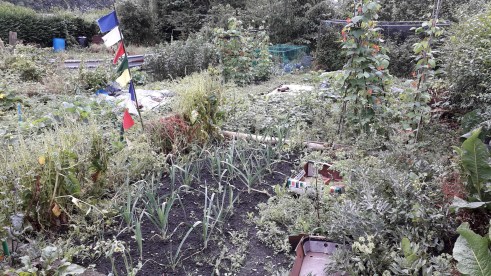 Regular work is required to keep the weeds under control. Since I don’t always do this weeding as frequently as I ought to, the plot as a whole quickly becomes a jungle of assorted greenery instead of neat rows of plants, growing in well defined beds and borders. It’s easy to despair and abandon the fight, letting everything grow together in the hope that it’ll sort itself out in the end. Unfortunately it doesn’t work like that. Making the most of the well composted and fed soil that was meant for the crops, the weeds flower and spread their seeds around the plot long before my crops have matured, guaranteeing me the same problem for years to come, unless I do something about it.
 If only they’d gone to the opticians! In a recent one, a joiner puts a back door on upside down, so that the cat-flap is at the top. The workman finishes the job and goes on his way, unaware of his mistake, whilst the mystified cat sits there gazing up at the unreachable cat-flap.
 where she lived. Her courage in telling her story in such a beautiful way was very moving and brought compassion and connection. When we make ourselves vulnerable like she did and choose to speak up about our struggles and who we are, we’re no longer allowing them to have any power over us, rejecting the shame we feel they contain and the self-hatred that can result. God stands with us in this and rather than condemning us, works through our story. Letting go of what we always held onto so closely can be what heals us the most, and incredibly, helps others who hear our story to find healing too. So let’s not be afraid of who we are or of starting to tell our stories. As the author Neil Gaiman says, “The one thing that you have that nobody else has is you. Your voice, your mind, your story, your vision. So write and draw and build and play and dance and live as only you can.”
 The story follows a London gangster, Jack Carter played by Michael Caine who travels back to Newcastle-upon-Tyne, his home town to investigate the events surrounding his brother Frank’s supposedly accidental death. He becomes increasingly convinced that his brother was murdered and ruthlessly interrogates those who may know something, with his mind set only on revenge. It ends violently with his own death, but not before he has dealt with those whom he holds responsible for his brother’s death.
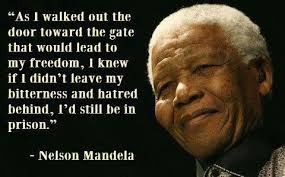 Archbishop Tutu says that “Forgiving is a gift to the forgiver as well as to the perpetrator. As the victim, you offer the gift of your forgiving to the perpetrator who may or may not appropriate the gift but it has been offered and thereby it liberates the victim. It would be grossly unfair to the victim to be dependent on the whim of the perpetrator. It would make him or her a victim twice over. The gift has been given. It is up to the intended recipient to appropriate it. The outside air is fresh and invigorating and it is always there. If you are in a dank and stuffy room you can enjoy that fresh air if you open the windows. It is up to you.” This, it seems to me is equally true for the wrong-doer when they ask for forgiveness and it is not given. They can do no more, but it in no way lessens the importance of what they have done in releasing them. Many people who have undertaken steps 8 and 9 can vouch for the truth of this when their attempts to make amends and admit their wrongs have not been accepted. It still allows them to move forward in the process. Meanwhile the one who was wronged is also on a pathway which may ultimately lead to them accepting the gift and breathing freely of the clean air of forgiveness. Not to do so will only hurt themselves. As is so often said in recovery about carrying wrongs and resentments, we are allowing the wrong-doer to live rent free in our heads. It can help to remember that everybody has experience as both a doer of wrongs and a recipient of wrongs. Dealing with our part in both of these helps us to remain emotionally and spiritually healthy.
 The Way of Jesus and Twelve Step Recovery