It takes a brave person to give up everything and voluntarily rely upon the help of others to achieve a goal. The Kindness of Strangers is a book by Mike McIntyre, a journalist from California, who, feeling unfulfilled and trapped by his safe life, left his job and without any money, travelled coast to coast across the United States, relying upon other people’s acts of kindness to help him. To make it even more challenging he refused to accept gifts of money.  Six weeks later, having met many wonderful, kind people, he completed his life-changing journey, having travelled 4233 miles, across 14 states, getting 82 rides, 78 meals, 5 loads of laundry and a round of golf! He noticed how often it was people with very little, or those who had experienced terrible, tragic events in their lives who not only took the risk to help him but gave with immense generosity too. The book’s real strength lies in the way he introduces us to these people and how their kindness comes to touch our lives too.
Kindness is the outworking of loving our neighbour as ourselves, which Jesus spoke of as the second great commandment. Jesus is constantly referred to as showing compassion to people he meets and to all those with great need whom he healed, taught and fed. His stories too were often about the importance of showing kindness, compassion and generosity to others – the good Samaritan, the parable of the sheep and goats, and when he received an act of great kindness from a repentant woman who poured expensive perfume on him, he predicted that her story would be told for ever. Kindness is also one of the nine fruit of the spirit mentioned by St Paul.
Central as compassion and kindness are within the teachings of Jesus, they are by no means the monopoly of those following his way. Kindness is encouraged within all the World’s great religions, but it is not even exclusive to religion, for those with no religious beliefs at all embrace the importance of kindness and look for ways to practice it. Kindness seems to transcend all people, beliefs and nations and research suggests that positive relationships and kindness are at the heart of our health and well-being.
A recent report from the Carnegie Trust argues that nowadays many people feel an increasing sense of risk in engaging with others and asking for or giving help. As a result, there is a tendency to use more formal routes to help those in need, and we measure kindness in contribution to organised charity rather than our individual interactions with people. Unfortunately, these charitable organisations are also increasingly preoccupied by risk, which together with growing levels of bureaucracy, regulation, performance indicators and professional detachment, crowds out everyday kindnesses and the intuitive nature of kindness. This certainly resonates with my experiences. I can only think it fortunate that the Good Samaritan didn’t have to risk assess, impact evaluate, time-manage or outcome measure his involvement with the victim of robbers he found by the roadside! He just helped him. The Carnegie report concludes that those things which ‘get in the way’ need to be balanced with a greater confidence and support in the value of trust, goodwill, affection, warmth, gentleness and concern.
Within the 12-step tradition, kindness is seen as an important way of helping us to stop being so self-absorbed, enabling us to look beyond ourselves. If we are thinking about other people, which requires some imagination, empathy and most important of all, action, then we are taking time out from just thinking about ourselves. At this point it is worth noting that there are those who say that in helping others or being kind to them, we are still self-absorbed and preoccupied with our feelings, and are only acting in this way in order to feel good about ourselves. Well, this may or may not be true, but even if there is no such thing as altruism, (which I dispute), I would still always choose to live in a world where people are kind to one another and do good things for others, whatever their underlying reason for doing so. When Mike McIntyre was feeling guilty for putting on people who often had very little, one of those who had helped him said, “Mike, on this trip keep in mind that when people give you something, there’s always a reason for it. They have their own motivations for helping you.” Compassion, helping and kindness are virtues whatever the motivation. Period.
Kindness has a ripple effect. When somebody does an act of kindness, it can not only affect both the doer and the receiver in personal, emotional ways, but it also affects other people who hear the story. At a surface level we may be impressed at the kindness somebody has shown, but at a much deeper spiritual level we are moved by the way the actions unlock something much more profound about ourselves and our lives together. Kindness promotes connectedness and this I think is touching on what Jesus referred to as the Kingdom of Heaven. So, as well as doing acts of kindness, we need to speak about acts of kindness too, rippling the effects more widely afield.
Acts of kindness are unilateral and radical. In a world where so much isn’t in our control, we have complete license to do acts of kindness, to pretty much whoever we want, whenever we want to do them. A year or two ago I did a bit of guerrilla gardening. I used to walk to work across an uninspiring trading estate, which apart from a few spring bulbs and flowering trees, had little in the way of natural beauty amidst the roads, offices and factories. I made small dried cakes of compost, fertilizer and seeds and deposited them on the muddy verges and derelict sites. Being an inherent coward, I didn’t hurl them like grenades or Molotov cocktails in case some lurking security guard challenged me. Rather like prisoners of war in the Great Escape who dropped waste soil from their escape tunnels down their sleeves or trouser legs whilst walking around the compound, I would furtively release the flower bombs from my pockets without breaking stride, all the while looking in a completely different direction. This approach did mean that my aim and the distance achieved were not all they might have been but in time there was some success. It was not the greening of the estate with fields of flowers drawing astonished crowds as I had fantasised, but flowers did grow and maybe in time more will appear as they seed themselves and dormant seeds begin to sprout. In the same way, random acts of kindness each day can spread the seeds of hope, love and connectedness which will flower and in time spread more widely.
Finally, acts of kindness do not require a lot of resources. Sure, we can give gifts or money away, but kindness is not really about the size or scale of the act. Jesus commended the poor widow for what she gave, not because of the size of her gift but because she gave out of what little she had. Kindness is all about the thought and willingness to think about the needs of others, to put ourselves out, or give up a bit of time, comfort or security for the sake of someone else.
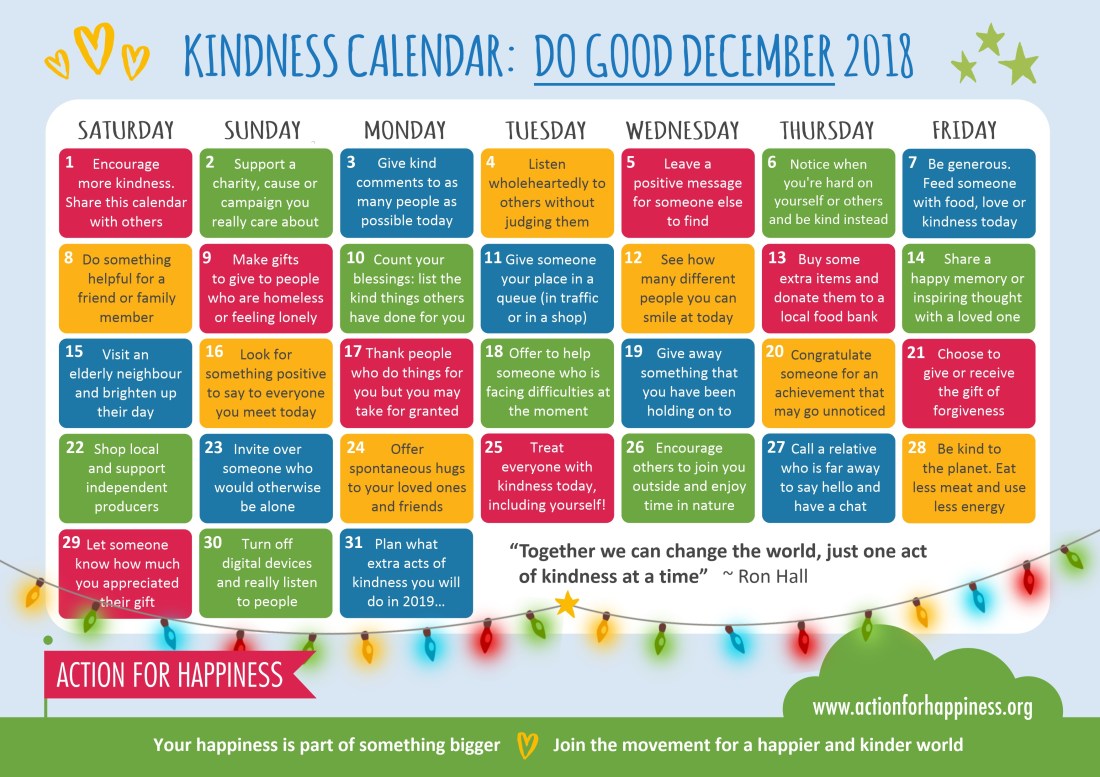
Hearing about acts of kindness or reading about them in Mike McIntyre’s book, I know that I tend to see myself as the generous giver. But the reality is almost certainly a little different. Would I really take a stranger into my house or find the time to accompany him to a café and pay for his food and enjoy his company, or do I regard it as too risky, myself as too busy or else find one of a myriad of other excuses for passing by on the other side. In a crowd of people I know, do I go to talk to the person who seems alone or do I stay safe and look after my own wants? Do I worry that an act of kindness will seem foolish or weak? If I am to break out of such self-interest, self-absorption and fear I need people, methods or tools to help challenge me to step out of my comfort zone and do more acts of kindness that may have a cost to me. The ‘Just for Today’ Card popular amongst all 12 step fellowships, with its many actions that we can manage to do for one day, can be a very helpful tool. Part of it offers both an active suggestion for kindness and a reactive way of behaving kindly: “Just for today I will do somebody a good turn and not get found out; if anybody knows of it, it will not count…… Just for today I will not show anyone that my feelings are hurt; they may be hurt, but today I will not show it.” Both actions are more challenging to do than they sound, and in trying to do them they reveal a great deal to us about who we are and how we relate to those around us. And they will both help us to be more kind. We may want to have a month of kindness – thirty days which can have a lasting effect upon how we look to the needs of others. Or it may be an outworking of Christmas goodwill, or a New Year’s resolution. How we help ourselves to start matters much less than actually doing random acts of kindness whenever we can. In doing them we become guerrilla gardeners of kindness, helping to make a brighter, better world.
Kind hearts are the gardens. Kind thoughts are the roots. Kind words are the blossoms. Kind deeds are the fruits. 19th Century children’s rhyme
Beginning today, treat everyone you meet as if they were going to be dead by midnight. Extend to them all the care, kindness and understanding you can muster, and do it with no thought of any reward. Your life will never be the same again. Og Mandino
A single act of kindness throws out roots in all directions, and the roots spring up and make new trees. Amelia Earhart
A bit of fragrance always clings to the hand that gives roses. Chinese Proverb
Kind words can be short and easy to speak but their echoes are truly endless. Mother Teresa
Suffering is only intolerable when nobody cares. I continually see that faith in God and his care is made infinitely easier by faith in someone who has shown kindness and sympathy. Dame Cicely Saunders
 He even takes the blame for his brother’s cannabis to protect him from receiving the same shame and rejection that he has already experienced from his parents. Towards the end of the final series Jesse is overwhelmed by guilt and the “blood money” that he possesses. He attempts to deal with this by throwing a bag of money out of his car window and trying to give it away to people in need, or those to whom he has a connection. Whilst we may all use various means of anaesthetic or mental justifications and rationalisations to be like Walt and protect ourselves from feeling guilt and shame, in reality most of us are more like Jesse. Even if we pull it off, it is exhausting and ultimately can become overwhelming.
 People in 12 Step recovery get how important the present is – working the programme one day at a time is a central understanding. Rather than dwelling on the past or future, the only option for getting well is to focus on the present. “If we don’t take that first drink today, we’ll never take it, because it’s always today,” wrote Richmond Walker, author of 24 Hours A Day, AA’s first book of meditations. From its earliest days, AA built on this ‘one day at a time’ approach to recovery, though the source of this principle seems to have been lost in the mists of time. The early AA meetings were very influenced by the Oxford Group so possibly it came from there, and many of those meetings also included saying the Lord’s Prayer, which Jesus taught his followers. Give us today our daily bread – not tomorrow’s or next week’s bread – just what we need today. This prayer comes in Jesus’s Sermon on the Mount manifesto. In it he saw the importance of living today and urged us to live in a trusting relationship with God each day, as the flowers and the birds do, rather than worrying ahead. “Can all your worries add a single moment to your life?” If we feel unsure and anxious about future events, it can help to remember that in the past we have always had the energy and resources to deal with any particular present moment when it arises. God gives us what we need, when we need it. If I need to do anything about the future now, then I should do it – for example, buying a train ticket in advance to secure a seat and the best price, but after that, letting go, and not worrying about whether the train will run to time, whether my seat might already be occupied and so on. Whatever happens on the day of travel will be fine, because I will be able to cope with it at the time. We need to keep reminding ourselves of this to correct our false thinking and the compulsion to worry, affirming instead that we are precious and cared for, each and every day and that we will receive the resources and energy to cope with things as and when they arise. Life isn’t always sugar coated, but nothing, absolutely nothing can separate us from this loving provision of God. We just need to let go and trustingly, surrender to it.
 The Way of Jesus and Twelve Step Recovery