Recently I heard a news report about a politician who was standing down from office. “He has served his community for more than thirty years”, the reporter said. It set me to thinking about service and what it really means, because whatever contribution politicians make, service is not a word I associate with an activity so based around the desire for and wielding of power. Many of the “services” we now receive are delivered by large organisations with rigid hierarchical power structures for the thousands of people they employ to “serve” us, be they health, military, police, national, regional or local government. Whilst as institutions they do of course serve our needs for health, safety, protection, amenities and so on, true service and servanthood is something very different. It’s marked by humility, self-sacrifice, disregard for power, preferring the interests of the other, generosity and self-effacement. There are undoubtedly some individuals in the large service organisations who do serve in this way, but the majority appear to do it primarily for the paycheque, the power, the prestige or for a combination of these things.
Jesus was truly revolutionary in his approach to power and authority. Though servant leadership is a term that has only been used in the last 50 years or so, Jesus introduced his followers to the principles two thousand years ago. It was incredibly radical. “Whoever wants to become great among you must be your servant, and whoever wants to be first must be your slave, just as the Son of Man did not come to be served, but to serve.” (Matthew 20 26-28). Jesus’s words were lived out in his life, where he consistently expended himself for others, but perhaps his notion of service is most clearly displayed in his washing of the disciples’ feet on one occasion shortly before his death. This was a menial, despised job, not something for a leader, let alone a king. And he washed the feet of all of his disciples, including Judas who was about to betray him. Followers of Jesus should, as he said, seek to serve people and not lord it over them. Service is never about power, pride or status.
Service is very important in 12 step recovery. The early pioneers understood the paradox within the teachings of Jesus that “we must give it away if we are to keep it”. All within fellowships are there to serve, recognising that service is essential to recovery. The Twenty-Four Hours a Day book author likens recovery without service to the Dead Sea. It is service which keeps us fresh and alive. And service, as Bill W says, is “anything whatever that helps us to reach a fellow sufferer — ranging all the way from the Twelfth Step itself to a ten-cent phone call and a cup of coffee.” Serving is a way of looking beyond our ego driven selves to consider the needs and struggles of others, so teaching us a different way of living.
One of the many amazing things about the 12 step programme is the way in which it operates with the minimum of power – positions are temporary and always done as a service to help others and to help one’s own recovery. As Tradition Nine says, “We create Service boards or committees directly responsible to those they serve”. In A.A. groups, these trusted servants are sometimes called “officers” and usually are chosen by the group for limited terms of service. Tradition Two says, “Our leaders are but trusted servants; they do not govern.” These service positions may have titles. But titles in A.A. do not bring power or status, they simply describe roles and responsibilities. Chairing a 12 step meeting is both a service opportunity and a unique chance to practice the principles learnt in A.A, especially one of humility. It’s been said that most mistakes made by a chairperson arise from a false feeling of ego, power or control which simply shows that they have more to learn about humility.
Given that Jesus declared that the path to greatness lies in humble service, it is surprising how consistently the Christian church is based upon positions of power and authority and how many individuals within the church have been caught up in the pursuit of this power. All too often we see signs of abuse of power, with pride in positions of status and prestige clothed in false humility. It is remarkable that the heady attraction of power and the ever-present pitfalls from our personal weaknesses have been so consistently disregarded, given that Christianity in all its forms is based on a common belief in our human fallibility and sinfulness. Churches lack the built-in safeguards which the founders of A.A. inspirationally put in place for their meetings and structure. As a result, whereas 12 step organisations and their overall structures are upside down, with ultimate responsibility and final authority for services residing with the groups, the church is a traditional pyramid structure with power generally resting at the top. Ironic really, because Jesus heavily criticised the religious power pyramid of his time and the Kingdom of Heaven he spoke of, is very much an upside down, topsy turvy model of living.
As they say, it is what it is, so as followers of Jesus we have to work with what we’ve got and the way that things are. Our job is to put into practice the things he taught, loving our neighbour as ourselves, so we serve without expecting anything in return whether that be awareness, reward or recompense. As Jesus showed too, we serve those who are opposed to us as well as those who do not value or appreciate what we do. We need to be very, very wary of power and find some way to build in our own personal checks and safeguards if we are in positions of power and prestige. Hard as all of this may be, we must trust that as we do seek to serve with genuine humility and as we show love through this service, it creates ripples which extend far beyond us. “To keep it you have to give it away,” and by giving of ourselves we not only advance the Kingdom of God, but somehow, miraculously, we are fed and become full ourselves.
Now that I, your Lord and Teacher, have washed your feet, you also should wash one another’s feet. I have set you an example that you should do as I have done for you. Very truly I tell you, no servant is greater than his master, nor is a messenger greater than the one who sent him. Now that you know these things, you will be blessed if you do them. Jesus of Nazareth
The life of a man consists not in seeing visions and in dreaming dreams, but in active charity and in willing service. Henry Wadsworth Longfellow
Service which is rendered without joy helps neither the servant nor the served. But all other pleasures and possessions pale into nothingness before service which is rendered in a spirit of joy. Mahatma Gandhi
Joy can only be real if people look upon their life as a service and have a definite object in life outside themselves and their personal happiness. Leo Tolstoy
What brings you closer to God is being in service to others. Any religion or spiritual way of life will indicate that service to others will lead to a connection with a higher power. Anonymous
How can I be useful, of what service can I be? There is something inside me, what can it be? Vincent Van Gogh
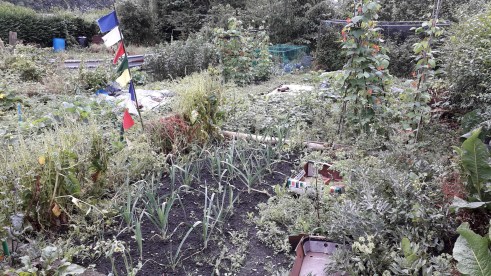 Regular work is required to keep the weeds under control. Since I don’t always do this weeding as frequently as I ought to, the plot as a whole quickly becomes a jungle of assorted greenery instead of neat rows of plants, growing in well defined beds and borders. It’s easy to despair and abandon the fight, letting everything grow together in the hope that it’ll sort itself out in the end. Unfortunately it doesn’t work like that. Making the most of the well composted and fed soil that was meant for the crops, the weeds flower and spread their seeds around the plot long before my crops have matured, guaranteeing me the same problem for years to come, unless I do something about it.
 If only they’d gone to the opticians! In a recent one, a joiner puts a back door on upside down, so that the cat-flap is at the top. The workman finishes the job and goes on his way, unaware of his mistake, whilst the mystified cat sits there gazing up at the unreachable cat-flap.
 where she lived. Her courage in telling her story in such a beautiful way was very moving and brought compassion and connection. When we make ourselves vulnerable like she did and choose to speak up about our struggles and who we are, we’re no longer allowing them to have any power over us, rejecting the shame we feel they contain and the self-hatred that can result. God stands with us in this and rather than condemning us, works through our story. Letting go of what we always held onto so closely can be what heals us the most, and incredibly, helps others who hear our story to find healing too. So let’s not be afraid of who we are or of starting to tell our stories. As the author Neil Gaiman says, “The one thing that you have that nobody else has is you. Your voice, your mind, your story, your vision. So write and draw and build and play and dance and live as only you can.”
 Interestingly, recent surveys in the UK have shown that 60% of adults believe in miracles, even though those who would claim to have any sort of religious faith is far lower. An amazing 72% of people aged 18 to 24 believe miracles can happen — more than any other age group. Figures are even higher in the United States. One of the greatest and most consistent miracles of our time is how people with severe addictions have had their lives saved by following a 12-step programme of recovery. So God is still restoring sight to the blind. Not only have their lives been saved, but they live life in a new and different way – life in all its fullness was how Jesus described it, because they have had their spiritual sight restored. And in the most interesting parallel to the story in John’s gospel, there are many doubters of these miracles; those within the treatment establishment, who take offence at the self-help, spiritual nature of this programme. “What place does the idea of God have in treatment provision?” they say. “This only works for a small number of people”. Academics too have their doubts and demand “an evidence base” when there are hundreds of recovered people now well, against all the odds, a walking, talking evidence base. “Isn’t going to AA meetings just another addiction” someone in the church once said to me, oblivious to the fact that they probably attended as many church services a week as most people in recovery attend meetings, yet they would never see this as an addiction or sign of weakness. So the miracle is ignored. But it doesn’t go away. Like the light, salt, and yeast that crop up repeatedly in the stories of Jesus, people in recovery are quietly, steadily and miraculously playing their part in God’s big plan of restoration, the Kingdom of God that Jesus talked about. Research has shown that 5 years into sobriety, people in 12 step fellowships are contributing more to society than others who have never had an addiction.
 The Way of Jesus and Twelve Step Recovery