It’s a busy time of the year down at my allotment. I share the plot of rented land with a couple of friends and right now the fruit and vegetables are at their most productive. This year the combination of warm sun, heavy rains and damp, muggy air have not only benefitted the crops but also made it a paradise for numerous weeds and uninvited plants. For some unknown reason, the weeds grow more rapidly and far more profusely than the strawberries, chard, beans, beetroot and leeks that I am trying to grow. 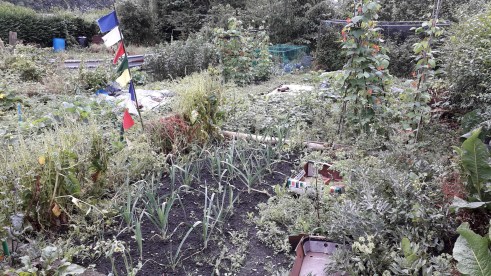 Regular work is required to keep the weeds under control. Since I don’t always do this weeding as frequently as I ought to, the plot as a whole quickly becomes a jungle of assorted greenery instead of neat rows of plants, growing in well defined beds and borders. It’s easy to despair and abandon the fight, letting everything grow together in the hope that it’ll sort itself out in the end. Unfortunately it doesn’t work like that. Making the most of the well composted and fed soil that was meant for the crops, the weeds flower and spread their seeds around the plot long before my crops have matured, guaranteeing me the same problem for years to come, unless I do something about it.
The parallel for our own lives is not hard to see, partly because many of us are familiar with Jesus’s stories of crops and weeds along with good and bad soil. The parable of the sower which is recorded in three of the gospels, is particularly well known, with the seed failing to germinate, growing poorly or flourishing, depending on the soil conditions where it had been sown. This is exactly what does happen – plants sown on the edges or growing close by are smaller and much less productive than those in the central, more fertile areas; plants with weeds around them have to compete for light, water and nutrients and also grow far less well than those in cleared ground. Those in weed-free, well-watered and composted areas are by far the most productive. Likewise, in our own lives we need good fertile environments in which to thrive and an absence of things which choke or stifle our spiritual growth.
In twelve step programmes the need to deal with these impediments to growth is a vital part of recovery, dealt with most clearly in steps 5,6 and 7. Making a moral inventory is a revealing process, showing us just how widespread and deep our wrongs and failings are. It is not the more glaring shortcomings we have that shock but the small hidden things, including our negative responses to the events of our lives. I came to see how many and how deep my resentments were towards people and circumstances of life – recent and long past. Because we are powerless to move on from or eliminate these things ourselves, we have to ask God, our Higher Power to remove these character defects and shortcomings. We must not only remove the weeds and clear the ground, but as I know only too well from both my allotment and my own life, we need to continue to manage them, because weeds continue to grow. Sometimes too it takes time to completely get rid of the deep roots of established weeds in our lives which can grow back. We need to find some way to reflect on and keep on top of these things. So it is no wonder that step 10 helps us to do this by “continuing to take a personal inventory and when we are wrong promptly admitting it”. Handing things over to our Higher Power is always central, and a reminder that our lives remain unmanageable if we try to do it alone. But neither Recovery nor following Jesus are passive activities and we have to play our part not least in wanting things to change. As they say in the rooms, “we alone can do it, but we cannot do it alone”.
I am not sure that there is the same amount of work put into deep reflection, admission and clearing of ground by many of us Christians as there is by those in recovery. Admit your wrongs and move on via a quick general confession is often the process and too much time dwelling on your failings is seen as beating yourself up rather than basking in the grace of forgiveness and new life. Of course this can happen, with guilt trapping us in an unhealthy whirlpool of despair, far removed from the freedom which Jesus promised. But like weeding, the purpose is to clear the ground, not feel bad that weeds have grown and as a general rule some sort of moral inventory is a helpful and productive thing to do periodically, preferably with the support of a spiritual mentor or guide, who will help us to avoid unhealthy levels of guilt. As the Desert Fathers discovered, true spirituality begins with the acceptance of our own flaws and limitations and in the compassion that emerges from this self-knowledge – compassion towards ourselves, towards others and towards all of humanity. We are all beautiful but flawed and we are all in this together.
As well as slowly clearing the ground (and it really can be slow work), we also need to water and feed the ground of our lives to make them fertile. We must dig deep wells to find the things which feed and nurture us, like the living water which Jesus said flowed from him. Serving others and helping the stranger is a sure yet mysterious way to receive nourishment and spiritual blessing. Step 11 talks of prayer and meditation as being a means of helping us to improve our conscious contact with God, seeking guidance and help with our lives. Jesus’s life and ministry was totally reliant upon prayer and time spent alone with God, enabling him to be obedient to his calling, proclaiming the Kingdom of God here on earth.
A common prayer in 12 step circles is the Set Aside Prayer. I forget who it was I read who developed this into a fuller prayer which helped me so much (Heather King, I think), and which in turn I have amended to capture the things which my moral inventory revealed were the weeds of my life which will choke the growing seed if I do not seek to manage or remove them on a daily basis. So, with grateful thanks to whoever it was who wrote the first version, here is my take on the Set Aside Prayer.
“Loving God, please set aside everything I know or think I know about spirituality, religion and faith that has become formulaic or gets in the way of new understanding. Set aside every idea that has frightened, threatened or angered me. Set aside everything that’s been forced down my throat, that’s inconsistent, that manipulates me. Set aside all my resentments and the ease with which I find and harbour new ones. Set aside my desire to be in control and my discomfort when I’m not. Set aside my tendency to see things through the lens of my emotions of the moment. Set aside my constant judging and categorisation of other people. Set aside my worry and anxiety about almost everything. Set aside my plotting and planning about how I’d like things to be and my unconscious expectations that things should be perfect. Set aside my addictions, my doubts, my guilt, my shame, my jealousy, my rage, my intolerance. Set aside all these things and anything else which prevent me from having a loving heart, an open mind and a fresh experience of you today. Amen.”
Gardens are not made by singing ‘Oh, how beautiful,’ and sitting in the shade. – Rudyard Kipling
If your knees aren’t green by the end of the day, you ought to seriously re-examine your life. Bill Watterson
Most people don’t have the willingness to break bad habits. They have a lot of excuses and they talk like victims. Carlos Santana
Don’t let your sins turn into bad habits. Saint Teresa of Avila
When you find yourself in need of spiritual nourishment, it is in the opportunities to serve others that you will find the abundance you seek. Steve Maraboli
There are two types of seeds in the mind: those that create anger, fear, frustration, jealousy, hatred and those that create love, compassion, equanimity and joy. Spirituality is germination and sprouting of the second group and transforming the first group. Amit Ray
Becoming like Christ is a long, slow process of growth. Rick Warren
The Christian who has stopped repenting has stopped growing. A W Pink
 If only they’d gone to the opticians! In a recent one, a joiner puts a back door on upside down, so that the cat-flap is at the top. The workman finishes the job and goes on his way, unaware of his mistake, whilst the mystified cat sits there gazing up at the unreachable cat-flap.
 where she lived. Her courage in telling her story in such a beautiful way was very moving and brought compassion and connection. When we make ourselves vulnerable like she did and choose to speak up about our struggles and who we are, we’re no longer allowing them to have any power over us, rejecting the shame we feel they contain and the self-hatred that can result. God stands with us in this and rather than condemning us, works through our story. Letting go of what we always held onto so closely can be what heals us the most, and incredibly, helps others who hear our story to find healing too. So let’s not be afraid of who we are or of starting to tell our stories. As the author Neil Gaiman says, “The one thing that you have that nobody else has is you. Your voice, your mind, your story, your vision. So write and draw and build and play and dance and live as only you can.”
 Interestingly, recent surveys in the UK have shown that 60% of adults believe in miracles, even though those who would claim to have any sort of religious faith is far lower. An amazing 72% of people aged 18 to 24 believe miracles can happen — more than any other age group. Figures are even higher in the United States. One of the greatest and most consistent miracles of our time is how people with severe addictions have had their lives saved by following a 12-step programme of recovery. So God is still restoring sight to the blind. Not only have their lives been saved, but they live life in a new and different way – life in all its fullness was how Jesus described it, because they have had their spiritual sight restored. And in the most interesting parallel to the story in John’s gospel, there are many doubters of these miracles; those within the treatment establishment, who take offence at the self-help, spiritual nature of this programme. “What place does the idea of God have in treatment provision?” they say. “This only works for a small number of people”. Academics too have their doubts and demand “an evidence base” when there are hundreds of recovered people now well, against all the odds, a walking, talking evidence base. “Isn’t going to AA meetings just another addiction” someone in the church once said to me, oblivious to the fact that they probably attended as many church services a week as most people in recovery attend meetings, yet they would never see this as an addiction or sign of weakness. So the miracle is ignored. But it doesn’t go away. Like the light, salt, and yeast that crop up repeatedly in the stories of Jesus, people in recovery are quietly, steadily and miraculously playing their part in God’s big plan of restoration, the Kingdom of God that Jesus talked about. Research has shown that 5 years into sobriety, people in 12 step fellowships are contributing more to society than others who have never had an addiction.
 He even takes the blame for his brother’s cannabis to protect him from receiving the same shame and rejection that he has already experienced from his parents. Towards the end of the final series Jesse is overwhelmed by guilt and the “blood money” that he possesses. He attempts to deal with this by throwing a bag of money out of his car window and trying to give it away to people in need, or those to whom he has a connection. Whilst we may all use various means of anaesthetic or mental justifications and rationalisations to be like Walt and protect ourselves from feeling guilt and shame, in reality most of us are more like Jesse. Even if we pull it off, it is exhausting and ultimately can become overwhelming.
 People in 12 Step recovery get how important the present is – working the programme one day at a time is a central understanding. Rather than dwelling on the past or future, the only option for getting well is to focus on the present. “If we don’t take that first drink today, we’ll never take it, because it’s always today,” wrote Richmond Walker, author of 24 Hours A Day, AA’s first book of meditations. From its earliest days, AA built on this ‘one day at a time’ approach to recovery, though the source of this principle seems to have been lost in the mists of time. The early AA meetings were very influenced by the Oxford Group so possibly it came from there, and many of those meetings also included saying the Lord’s Prayer, which Jesus taught his followers. Give us today our daily bread – not tomorrow’s or next week’s bread – just what we need today. This prayer comes in Jesus’s Sermon on the Mount manifesto. In it he saw the importance of living today and urged us to live in a trusting relationship with God each day, as the flowers and the birds do, rather than worrying ahead. “Can all your worries add a single moment to your life?” If we feel unsure and anxious about future events, it can help to remember that in the past we have always had the energy and resources to deal with any particular present moment when it arises. God gives us what we need, when we need it. If I need to do anything about the future now, then I should do it – for example, buying a train ticket in advance to secure a seat and the best price, but after that, letting go, and not worrying about whether the train will run to time, whether my seat might already be occupied and so on. Whatever happens on the day of travel will be fine, because I will be able to cope with it at the time. We need to keep reminding ourselves of this to correct our false thinking and the compulsion to worry, affirming instead that we are precious and cared for, each and every day and that we will receive the resources and energy to cope with things as and when they arise. Life isn’t always sugar coated, but nothing, absolutely nothing can separate us from this loving provision of God. We just need to let go and trustingly, surrender to it.
 The Way of Jesus and Twelve Step Recovery