The first few pages of Jerome K Jerome’s story Three Men in a Boat, contain a very funny account by the narrator of how he read a medical text book and discovered to his horror that he had the symptoms of every illness and disease he looked at, apart from a mild form of cholera and housemaid’s knee! It’s amusing because most of us can identify with this sort of hypochondria, especially now that we have the internet, with countless medical sites containing descriptions of diseases and symptoms of illnesses, all of which seem to apply to us, when we read about them.
When we think about the themes of Grace, Guilt, Hope, Mercy, Gratitude, Forgiveness and Generosity covered in some of the blogs posted on this site over the last 18 months, there is probably a similar effect. We’ve got problems with every one of them. We feel as if we are constantly in deficit and are not good enough in any department. What became very clear to me early on, as I tried to write about these things on an individual basis, was that whilst they may appear to be separate, they are in fact part of a much bigger, interconnected whole.  The Golden Thread of Jesus’ teaching is many separate strands woven together, each with its own shade and lustre which together make the thread as strong and as golden as it is. A photograph of a golden thread seen through an electron microscope as it is passed through the eye of a needle shows clearly that the thread we thought was a single strand is in fact made up of many finer strands. (no wonder it is difficult to thread a needle!)
In reality however, they are more than just interconnected – they are actually interdependent in the sense that there is a dependence between things. For example, if I provide my dog with food and walks and my dog provides me with devotion and happiness, then my relationship with the dog is one of interdependence. Likewise, the individual strands of the golden thread are interdependent, each strand depending on another, which in turn depends on yet another. Thus, there can be no resolution of guilt without forgiveness, and this in turn requires mercy and compassion. The result of forgiveness is often gratitude. And of course, everything, absolutely everything is connected to and held together by love. So, we don’t have to feel despair about how little we may have of these things or what we must “get better at”. Nor do we need to think that we need to work to develop all of these things or set out a regime to “improve ourselves”. They are not ingredients in a cake or bottles of medicine and lotion that need to be taken daily in precise amounts. If I do X and Y then Z will happen. Such a formula would be all about us being in control, a false pathway. Because whilst it may offer some growth, the reality is that the process is much more of a mystery. If we can try to get the conditions right, then growth will happen, and what is amazing is that they all grow, not just one or another. That’s because they’re interconnected and interdependent, both within ourselves and between each other. So, whilst we do have our part to play, maybe by practising gratitude for 30 days, dealing with our resentments and forgiving or perhaps actively seeking to be more loving, after that it’s not down to us at all. As we so often find in the teachings of Jesus, and central to 12 step recovery, it’s all about letting go and letting God. The important lesson here is that spirituality, and the growth of the individual golden threads in our lives is through relationship rather than knowledge or achievement. And the real wonder is that the process of inner growth happens as we seek to serve and bless those around us, because none of the strands of the golden thread are just about us. This is the mustard seed or the yeast in the bread which Jesus talks about. The things which grow silently and miraculously if we let them, in ourselves and the people and community around us. Which once again brings us back to the Kingdom of Heaven, where all things connect, and everything works together for good.
I am still far from being what I want to be, but with God’s help I shall succeed. Vincent Van Gogh
I think we’d like life to be like a train…..but it turns out to be a sailboat. Barbara Brown Taylor
Did I offer peace today? Did I bring a smile to someone’s face? Did I say words of healing? Did I let go of my anger and resentment? Did I forgive? Did I love? These are the real questions. I must trust that the little bit of love that I sow now will bear many fruits, here in this world and the life to come. Henri Nouwen
Through my years of darkness, some spark of spirit remained in me, helped me survive until I found my way into A.A. Then, nurtured by the program, that inner spirit grew, deepened, until it filled the emptiness I had so long felt inside. Step by step I moved to a spiritual awaking. Step by step I cleared up the past and got on with the present. Alcoholics Anonymous, 4th Edition
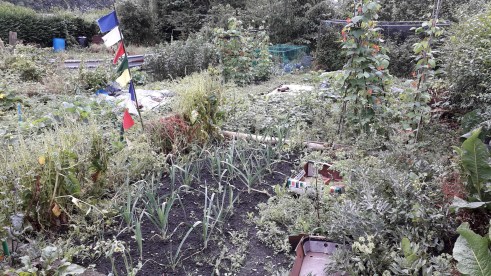 Regular work is required to keep the weeds under control. Since I don’t always do this weeding as frequently as I ought to, the plot as a whole quickly becomes a jungle of assorted greenery instead of neat rows of plants, growing in well defined beds and borders. It’s easy to despair and abandon the fight, letting everything grow together in the hope that it’ll sort itself out in the end. Unfortunately it doesn’t work like that. Making the most of the well composted and fed soil that was meant for the crops, the weeds flower and spread their seeds around the plot long before my crops have matured, guaranteeing me the same problem for years to come, unless I do something about it.
 If only they’d gone to the opticians! In a recent one, a joiner puts a back door on upside down, so that the cat-flap is at the top. The workman finishes the job and goes on his way, unaware of his mistake, whilst the mystified cat sits there gazing up at the unreachable cat-flap.
 The story follows a London gangster, Jack Carter played by Michael Caine who travels back to Newcastle-upon-Tyne, his home town to investigate the events surrounding his brother Frank’s supposedly accidental death. He becomes increasingly convinced that his brother was murdered and ruthlessly interrogates those who may know something, with his mind set only on revenge. It ends violently with his own death, but not before he has dealt with those whom he holds responsible for his brother’s death.
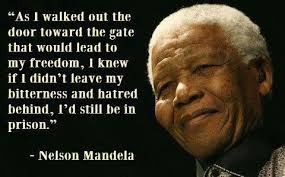 Archbishop Tutu says that “Forgiving is a gift to the forgiver as well as to the perpetrator. As the victim, you offer the gift of your forgiving to the perpetrator who may or may not appropriate the gift but it has been offered and thereby it liberates the victim. It would be grossly unfair to the victim to be dependent on the whim of the perpetrator. It would make him or her a victim twice over. The gift has been given. It is up to the intended recipient to appropriate it. The outside air is fresh and invigorating and it is always there. If you are in a dank and stuffy room you can enjoy that fresh air if you open the windows. It is up to you.” This, it seems to me is equally true for the wrong-doer when they ask for forgiveness and it is not given. They can do no more, but it in no way lessens the importance of what they have done in releasing them. Many people who have undertaken steps 8 and 9 can vouch for the truth of this when their attempts to make amends and admit their wrongs have not been accepted. It still allows them to move forward in the process. Meanwhile the one who was wronged is also on a pathway which may ultimately lead to them accepting the gift and breathing freely of the clean air of forgiveness. Not to do so will only hurt themselves. As is so often said in recovery about carrying wrongs and resentments, we are allowing the wrong-doer to live rent free in our heads. It can help to remember that everybody has experience as both a doer of wrongs and a recipient of wrongs. Dealing with our part in both of these helps us to remain emotionally and spiritually healthy.
 The Way of Jesus and Twelve Step Recovery