It now feels like a very long time ago that Coronavirus so rudely kicked down the front doors of our comfortable, stable, well-planned lives and unceremoniously marched on in. At long last, nearly eighteen months later, many of the worst affected countries are finally lifting their lockdowns and easing the various restrictions put in place to limit the virus’s rapid and seemingly relentless spread. It is noticeable, however that this gradual relaxation has been accompanied by signs of the usual human tendency to forget what we’ve been through and the lessons we thought that we’d learned, as we rush headlong to bury ourselves once again in what Heather King calls “the low-level anaesthetic haze of distractions and false gods.” There’s an old Irish blessing which says, “May you never forget what is worth remembering, nor ever remember what is best forgotten.” Maybe now is a good time for us to take stock and reflect on the things that we thought we’d learned during the Covid Pandemic but are now in danger of forgetting. We need to remember what is worth remembering.
Over the first six months of the pandemic there was a lot of talk about both love and suffering. Love was perhaps most clearly seen in the work of many of the frontline health and social care staff whose self-sacrificing care for the ill, lonely and dying went far beyond their job descriptions or professional expectations. Other essential workers, all too often the lowest paid people in our communities served us with immense dedication and love, keeping shelves stocked, food supplied, garbage cleared, fuel flowing and transport running. With schools and workplaces shut, families suddenly found themselves living close to one another 24/7 which required them to discover new depths of love, patience and tolerance. Love was also to be seen in many small acts of kindness for others in need in the community. People looked out for neighbours who were old or vulnerable, significant increases were seen in donations and contributions to local food banks and meal services, help was offered to those who could not manage. Little kindnesses of many sorts abounded. We discovered the truth of Mother Theresa’s words: “Not all of us can do great things. But we can do small things with great love.” Communities flourished and we dreamed of a greener, cleaner, more loving world.
The virus also caused much suffering too. Not just the premature and often painful death of nearly four million people world-wide, but also those who were acutely ill and survived, as well as relatives who suffered as their loved ones died alone and without the opportunity to say a final goodbye. Those who have developed ‘long-covid’ continue to suffer in painful and extreme ways. Elsewhere, many people with other health conditions suffered from temporarily inferior services and slower treatment as resources were shifted to fighting the virus. And all around us the poor, those in overcrowded living conditions, those in households where there was domestic violence, suffered even more than normal. Some experienced a double or triple whammy of these and other sources of suffering.
The majority of us, may not have experienced such extremes and instead found ourselves stuck in the lockdown hinterland of reduced options, dull routines and loss of purpose as its duration dragged on beyond any of our expectations. We just longed to get back to normal, whatever that new normal would look like. Yet, our eyes had been opened to a global vulnerability, and maybe we’d never have quite the same self-assuredness ever again.
Love and suffering have always been the most significant means by which we achieve spiritual growth. People in recovery know this and Jesus taught and consistently lived this truth. Addiction itself causes “acute and constant” suffering to both the addict and those around them and arguably the turning point is when the prolonged suffering caused by the addiction becomes too great to carry on. As the book Twelve Steps and Twelve Traditions says, “Until now, our lives had been largely devoted to running from pain and problems. We fled from them as from a plague. We never wanted to deal with the fact of suffering. Escape via the bottle was always our solution. Character-building through suffering might be alright for the saints, but it certainly didn’t appeal to us.”
The road to recovery is painful. The simple fact of living without a substance or process that we have always relied upon and having to stand without it, emotionally naked before the world is hard. Recovery is also painful because it requires change, most significantly the loss of ego which comes from our surrender. But wherever there is pain and suffering, love is usually there too, lurking in the shadows in the form of other people for whom this is a way of living and service. As the Big Book of AA says, “Love and tolerance of others is now our code.” In twelve step recovery, people find themselves drawn to others by acts of love; the duty which begin as a requirement of the programme ultimately develops into a way of life for the individual who gradually becomes loving and giving rather than selfish and taking.
The single most important message of Jesus was that God loves each of us and as a result will do anything to bring us back into his light. Anne Lamott says, “Sometimes I think God loves the ones who most desperately ache and are most desperately lost – his or her wildest, most messed-up children – the way you’d ache and love a screwed-up rebel daughter in juvenile hall.” The two great commandments of Jesus urge us to love the Lord God with all our heart, mind and strength and to love our neighbour as ourselves. No soft, sentimental love this, but a diamond hard centre of being, made so by the intense forces of costly self-sacrifice and suffering. As children of God we are to fill our lives with such love for God and others. Never one to ask anything of others that he did not do himself, Jesus lived this love to the full and experienced the process of dying to self. “Unless a grain of wheat falls into the ground and dies it cannot bear great fruit.” His brutal death brought great love and extreme suffering together in one final cataclysmic yet ultimately triumphant event.
None of this is news to most regular readers of this blog and certainly not to anyone with a strong recovery from addiction or Christian faith. One of the golden threads running through both is that love and suffering are our great teachers. But because we sometimes lose focus and our ego seeks to reassert itself from being in its rightful place and constantly tries to Edge God Out, it always pays to do a spiritual health check on how we’re doing, remembering that we so easily fall prey to self-deception. No time is better for doing this check than right now when things are starting to return to “normal.”
As I’ve said previously in these blog posts, I’m a real coward and will do my utmost to avoid pain and suffering if I can, but I am also a realist who knows it’s a fact of life and that somehow, at some point it will come knocking. In the meantime, whether suffering or not, we can always work at being better at loving others. So, the question is, each day, how can we better love those around us, not just by what we do but also by what we don’t do. Not saying the unkind, uncharitable things but only speaking words that encourage, build up and bring life. Giving the nicest and the best – not just the cheapest or most convenient, sharing the things we hold dear, sacrificing our time, comfort and ease. It’s the kind of love which has no price tag on it. Such love is steady and slow work, changing us without us ever knowing it’s happening. Life may sometimes feel dull or purposeless but the challenge to love those around us means that each day and in every situation, we are all called to be frontline workers. “Did I offer peace today? Did I bring a smile to someone’s face? Did I say words of healing? Did I let go of my anger and resentment? Did I forgive? Did I love? These are the real questions. I must trust that the little bit of love that I sow now will bear many fruits, here in this world and in the life to come.” (Henri Nouwen)
 My friend and I had already endured several hours of trudging through cold, biting rain flecked with sleet and a further hour clambering through ancient peat bogs which had at times left us struggling on all fours in order to get out. As we stood in the April mist, trying not to panic, the route where previously there had been other walkers and a fairly clear path, was no longer straightforward. Even using our map and compass was difficult, something that is so easy to do when it’s dry and sunny and you already know the right way. After some calm discussion and marking where we had been, we took some tentative steps forward into the mist and the unknown. Fifteen anxious minutes later we were very relieved to reach a trig point, which not only confirmed our position but revealed two young women who had already made it there. After a break for hot tea and some photographs, we headed off together from this point of security in the agreed right direction. In another twenty minutes we found a rough track and began to descend, emerging soon after into the April daylight. Although we were only about half-way, we sensed with relief that it was going to be alright.
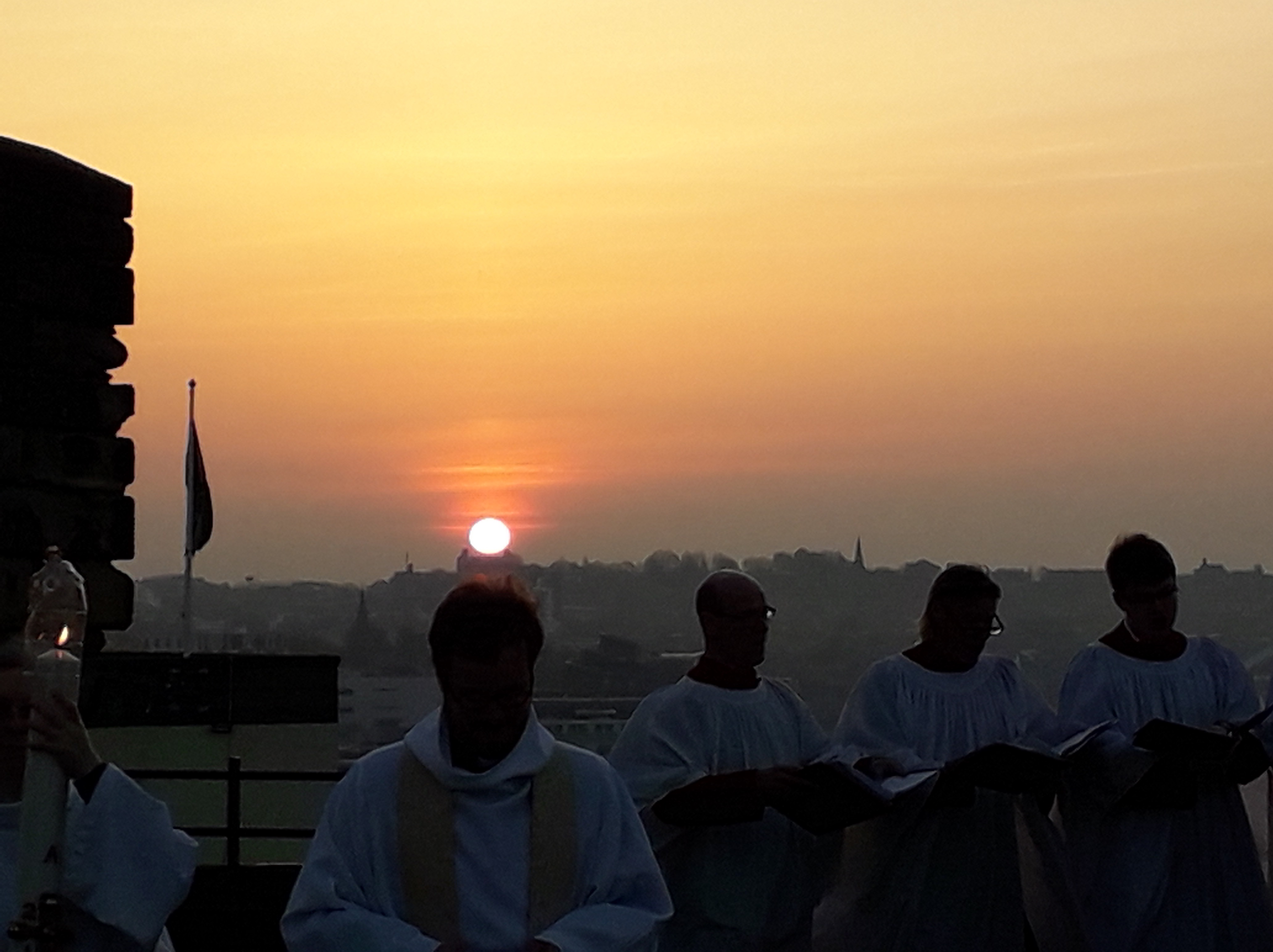 he rooftop where the fire is kindled and the paschal Candle lit as the sun starts to rise. This year we were not able to hold the service, but the glorious sunrise last year remained in my memory and the sadness about not celebrating the resurrection story in that way does not detract from the wonder of Easter. And that wonder is not limited to Easter Day but carries on in the days and weeks afterwards. For many outside the Church, Easter is done and dusted when the last Easter egg is consumed, but in the Church we continue to celebrate the season of Eastertide over subsequent weeks, discovering that the resurrected Jesus continues to bring us hope and joy, turning our sorrow into rejoicing. Reminding us that the downward path we have so often reflected upon in these blog posts is in fact part of the topsy turvy reality in the Kingdom of Heaven where we lose to gain, give to receive and die in order to truly live. Revealing that our systems of merit, worth and just deserts are not the ways the God of grace works at all. Showing us too that it is not about grim suffering and endurance but about finding joy, hope and happiness that go deep into the centre of our being as we discover who we really are and our hearts truest desires.
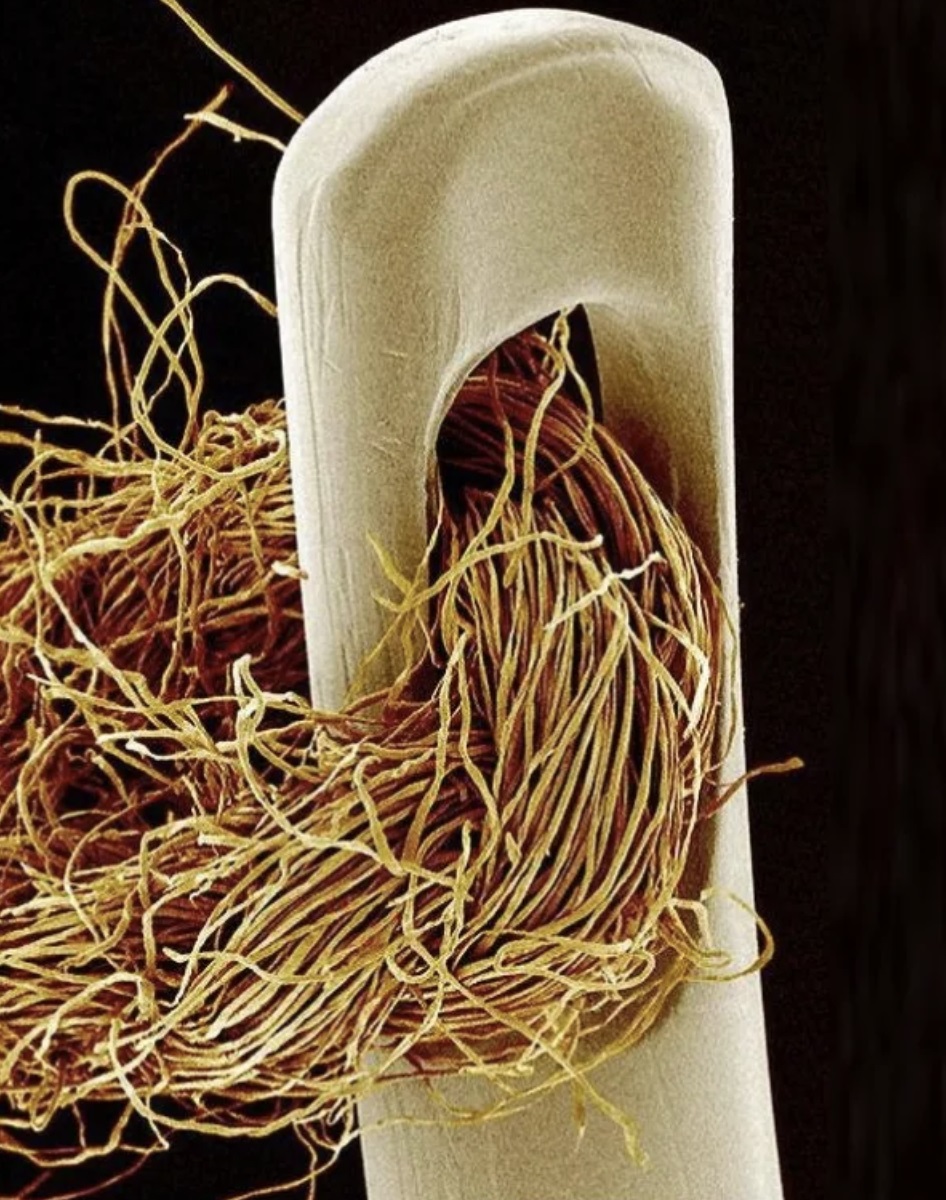 The Golden Thread of Jesus’ teaching is many separate strands woven together, each with its own shade and lustre which together make the thread as strong and as golden as it is. A photograph of a golden thread seen through an electron microscope as it is passed through the eye of a needle shows clearly that the thread we thought was a single strand is in fact made up of many finer strands. (no wonder it is difficult to thread a needle!)
 The Way of Jesus and Twelve Step Recovery