“I’m really grateful for one thing,” my brother said, “Dad taught us to be competitive and go in hard.” We were talking about my father and our upbringing, not long after his death. Even if this statement about him was true outside of the board games we used to play, his contribution was still only a small part of the big lie we are all told many times over, that life is about competing with other people and it pays to be ruthless in doing so. It is only in recent years that I have begun to see this lie for what it is, although changing the way I live is taking a whole lot longer.
From the start I want it to be clear that I’m not talking about winning at school sports, a game of monopoly or pool or even getting a job or wanting the football team you follow to win every match. Neither am I suggesting that wanting to achieve and excel at the things we do as individuals and in groups is wrong. What I am doing is kicking back against idea that absolutely everything in life is about competition and that this is an inevitable part of the evolutionary process. In other words, the notion that we are hard-wired to be competitive and competition is just another way of describing the survival of the fittest. Really? So the rush to get a seat on a crowded train or to be at the front of the dash into a store on the first day of the sales or to stockpile sugar, pasta, or flour is simply our need to provide for ourselves and those we care for? Even if there is a grain of truth in this, it quickly becomes a very unhealthy belief system to operate by, because the reality is that if I get what I want, this invariable results in someone else having less – no seat on the train, empty supermarket shelves and so on. The idea of competition and its alleged evolutionary source can so easily be an excuse or rationalisation for our selfish, greedy behaviour. What’s true for individuals is true for nations too. The current UK government has recently cut its overseas aid budget because it says the UK needs those resources more than other much poorer countries. When it’s got much richer, it will increase its aid budget again. Indeed.
Self-interest dressed up as competition could be seen in the subsistence farming economy of Jesus’s time – if a person accumulated crops in his barn and needed to build bigger barns to hold the grain then it was at the expense of others who had little or went without. No wonder Jesus’s parables often touched on this important area of life. His teachings suggest that we are meant to be in co-operation with God and with one another, not in competition, because there is plenty to go around. As beings created in God’s image, we have rationality and moral principles as our guide, not just survival and reproduction instincts. The early church at least was very much a community which had sharing and caring as its hallmark, following in the way of Jesus. It’s also a key element of recovery –we even talk about the recovery community. It’s not a competition about whose recovery is better or who is a better follower of Jesus. In the latter case we are all poor at it and the whole point about grace and mercy is that they are freely given to all of us, not just those who earn it or achieve a certain level of merit. And how do we respond to this grace? We serve one another, as Jesus taught us to do and showed in his life as a Servant Leader.
I always remember being moved by the slightly corny yet profound school assembly story of heaven and hell. Both were places with plenty of food but people could only eat using six-foot-long spoons. In hell everyone went hungry because they could not get the food into their mouths but in heaven everyone was full because they fed each other. In 12 step recovery this idea of working together and being non-competitive is perfectly illustrated by the complete absence of hierarchy and positions of status. The emphasis on service is very strong – again the model of Jesus as servant leader, and his counter-intuitive message that to become great we must become the least and the servant of all.
Pushing ourselves and having a competitive spirit isn’t a bad thing but the real lie is that this is what defines us as people. It’s even been said that extreme acts of heroism or altruism are really just self-serving actions, a cynical view of someone’s self-sacrificial act of giving and love for another. Love is what make us truly human and that is what both Jesus’ teachings and 12 step recovery are both about – making us more fully who we are meant to be and less the isolated, fearful, addicted people that the competitive world creates and fuels.
Christmas is a reminder that Immanuel is God with us, not God against us or watching us or even letting us sort it out for ourselves. God is with us, co-operating, working together to make the Kingdom of God a reality, not just seasonal bonhomie but good will to all, now and always.

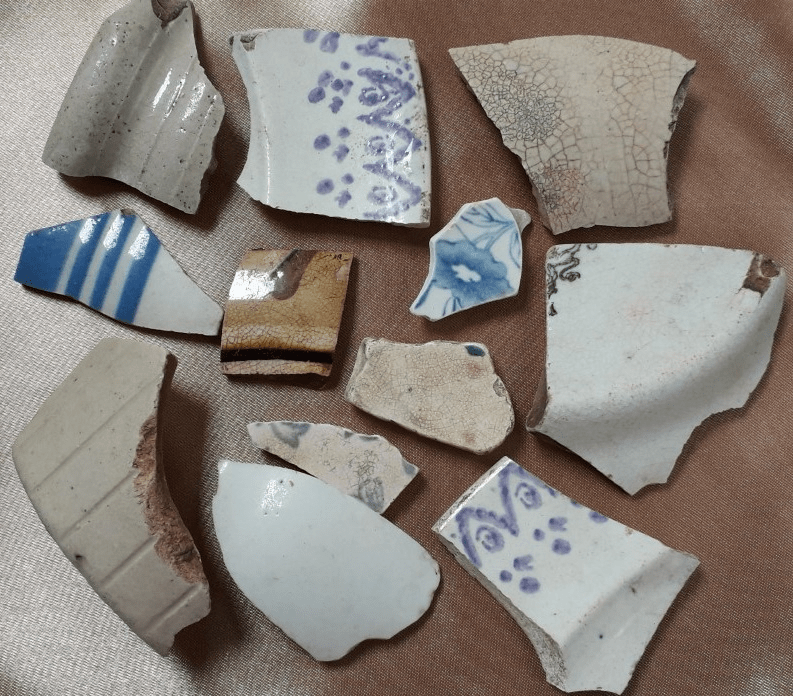
 My friend and I had already endured several hours of trudging through cold, biting rain flecked with sleet and a further hour clambering through ancient peat bogs which had at times left us struggling on all fours in order to get out. As we stood in the April mist, trying not to panic, the route where previously there had been other walkers and a fairly clear path, was no longer straightforward. Even using our map and compass was difficult, something that is so easy to do when it’s dry and sunny and you already know the right way. After some calm discussion and marking where we had been, we took some tentative steps forward into the mist and the unknown. Fifteen anxious minutes later we were very relieved to reach a trig point, which not only confirmed our position but revealed two young women who had already made it there. After a break for hot tea and some photographs, we headed off together from this point of security in the agreed right direction. In another twenty minutes we found a rough track and began to descend, emerging soon after into the April daylight. Although we were only about half-way, we sensed with relief that it was going to be alright.
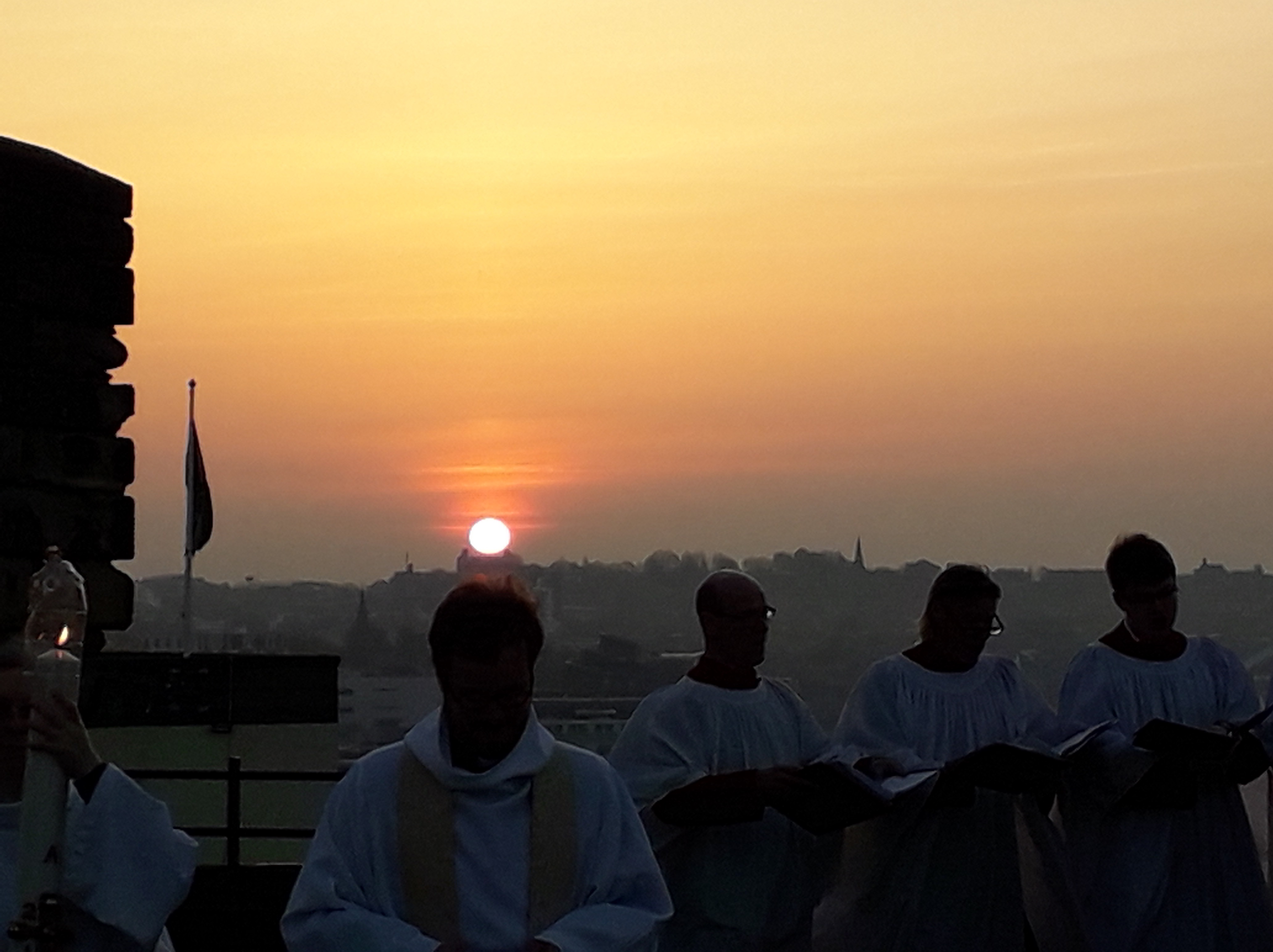 he rooftop where the fire is kindled and the paschal Candle lit as the sun starts to rise. This year we were not able to hold the service, but the glorious sunrise last year remained in my memory and the sadness about not celebrating the resurrection story in that way does not detract from the wonder of Easter. And that wonder is not limited to Easter Day but carries on in the days and weeks afterwards. For many outside the Church, Easter is done and dusted when the last Easter egg is consumed, but in the Church we continue to celebrate the season of Eastertide over subsequent weeks, discovering that the resurrected Jesus continues to bring us hope and joy, turning our sorrow into rejoicing. Reminding us that the downward path we have so often reflected upon in these blog posts is in fact part of the topsy turvy reality in the Kingdom of Heaven where we lose to gain, give to receive and die in order to truly live. Revealing that our systems of merit, worth and just deserts are not the ways the God of grace works at all. Showing us too that it is not about grim suffering and endurance but about finding joy, hope and happiness that go deep into the centre of our being as we discover who we really are and our hearts truest desires.
 The Way of Jesus and Twelve Step Recovery