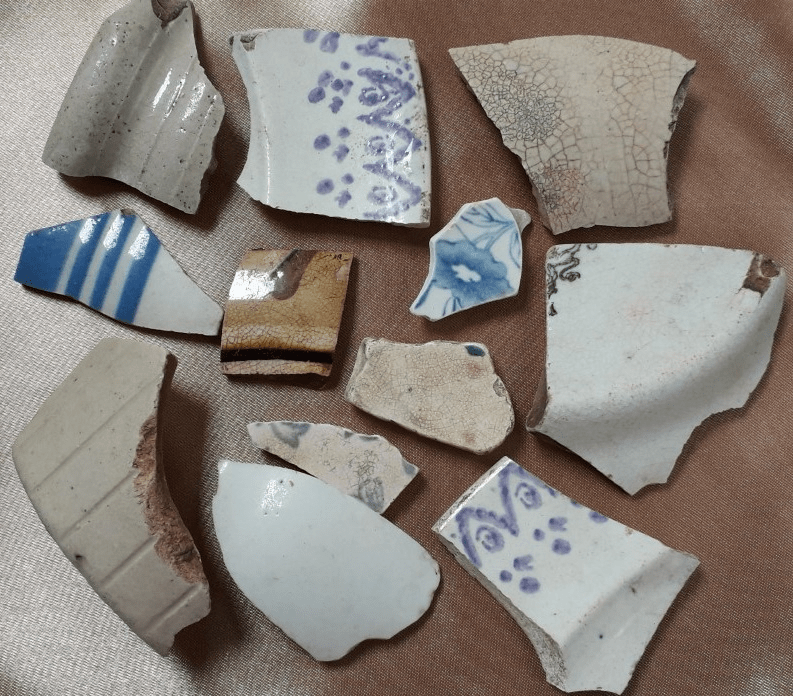
I love browsing in flea markets and junk shops. You just never know when there may be something of value hidden in the midst of all the tat and rubbish. It’s kind of ironic, really, because over recent years I’ve come to realise that my inner life also contains a great deal of clutter and trash. I may try to convince myself or others that it is a tidy, well organised place, full of unique pieces – interesting curios and charming antiques if you like, but unfortunately, it’s not really like that. Inside, there’s the cluttered rubbish of a junk shop – wrong ways of thinking, distorted memories and beliefs, long held resentments and unhelpful patterns of behaviour. I suspect too that I’m not alone in this if conversations with a few close friends or comments that I’ve read are anything to go by. As the author CS Lewis said, “on looking inside myself I found a zoo of lusts, a bedlam of ambitions, a nursery of fears and a harem of fondled hatreds.”
Jesus was well aware of our inner mess and was never fooled by those who were presenting themselves as neat and well-ordered. He responded in different ways. To the scribes and pharisees, self-righteous and proud, he was scathing: “Hypocrites! You are like whitewashed tombs, which outwardly appear beautiful, but within are full of dead people’s bones and all uncleanness.” On other occasions he was more sensitive, though just as clear about the problem. For example, when a rich man came to him asking what he needed to do to inherit eternal life, Jesus was gentle in his response when the man said that he had kept all the commandments since he was a boy. Jesus told him to go and sell all that he possessed, which got to the heart of the man’s inner problem – his wealth was a false source of security, an idol in the place of God, sadly too much for him to let go of at that point in his life. On yet another occasion Jesus spelt it out for us all when he said that “What comes out of a person is what defiles them. For it is from within, out of a person’s heart, that evil thoughts come.”
Twelve step recovery is also very clear about our inner mess, and it is probably fair to say that the bulk of the programme is about addressing this mess rather than the specific addiction. There is a clear recognition that it is the accumulated rubbish in our lives which not only pushes us towards addiction but keeps us there and creates wrong ways of living. This may be a result of things done to us, traumas suffered even, or it may be a consequence of incorrect ways of coping with the ups and downs of life, bad decisions we’ve made and wrong actions on our part. Whatever the cause, the result is the same and dealing with our inner mess is the stuff of almost half of the twelve steps, beginning with Step Four’s “searching and fearless moral inventory of ourselves,” followed up in quick succession by the next two steps where we admit to “God, ourselves and another human being the exact nature of our wrongs,” moving on to a point where we are “entirely ready to have God remove all these defects of character.” It is a way of living which deals with the rubbish in our lives that many of us would prefer to bury away from the scrutiny of others.
Because it’s an inside job, we must reply upon and co-operate with God, our Higher Power to do this work within us. Prayer and meditation is the central, golden thread through which we seek knowledge of God’s will for us and the power to carry it out. This is of course not a one-off event but a daily practice, which ultimately becomes a lifelong way of living. It’s not a solo flight either. We don’t have to do it alone – in fact we were never meant to. We need others to help us, through confession, spiritual direction, sponsorship, discipling, mentoring or even just plain, honest conversations and sharing over a cup of coffee.
Unlike Twelve Step Recovery, much of Christianity has now become a private faith, something that is just between ourselves and God, but when we do involve others and share something about our inner junk – our “dead bones and uncleanness” – we begin to find freedom and healing. This is helped by the fact that we not only find an acceptance from the other person about this part of ourselves and the things we have done/think which shame us, but invariably an acknowledgement by them that they are pretty much the same. We are not alone.
As jobs go, inner change is a slow business. At times it can be disheartening, because once we are aware of our inner mess, we tend to continue to notice the junk more than anything else. “All you can do is create a space for transformation to happen, for grace and love to enter,” says Ekhart Tolle. When we do, these mysterious currents of God’s Spirit get to work within us, highlighting our beautiful and valuable inner treasures to other people who are helped and blessed by them, even if we aren’t aware of it. Miraculously, when we change, the world changes a little bit too.

 My friend and I had already endured several hours of trudging through cold, biting rain flecked with sleet and a further hour clambering through ancient peat bogs which had at times left us struggling on all fours in order to get out. As we stood in the April mist, trying not to panic, the route where previously there had been other walkers and a fairly clear path, was no longer straightforward. Even using our map and compass was difficult, something that is so easy to do when it’s dry and sunny and you already know the right way. After some calm discussion and marking where we had been, we took some tentative steps forward into the mist and the unknown. Fifteen anxious minutes later we were very relieved to reach a trig point, which not only confirmed our position but revealed two young women who had already made it there. After a break for hot tea and some photographs, we headed off together from this point of security in the agreed right direction. In another twenty minutes we found a rough track and began to descend, emerging soon after into the April daylight. Although we were only about half-way, we sensed with relief that it was going to be alright.
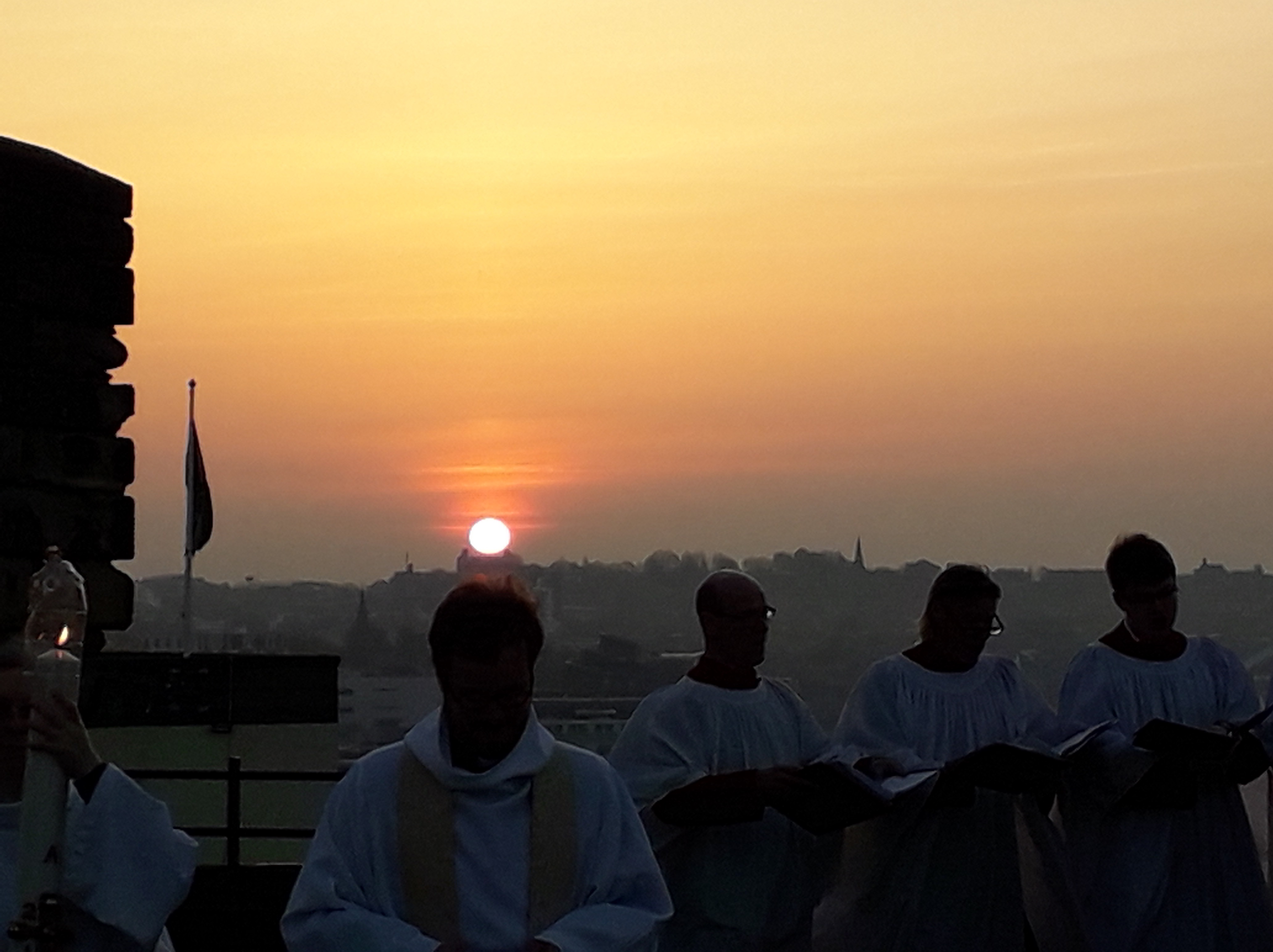 he rooftop where the fire is kindled and the paschal Candle lit as the sun starts to rise. This year we were not able to hold the service, but the glorious sunrise last year remained in my memory and the sadness about not celebrating the resurrection story in that way does not detract from the wonder of Easter. And that wonder is not limited to Easter Day but carries on in the days and weeks afterwards. For many outside the Church, Easter is done and dusted when the last Easter egg is consumed, but in the Church we continue to celebrate the season of Eastertide over subsequent weeks, discovering that the resurrected Jesus continues to bring us hope and joy, turning our sorrow into rejoicing. Reminding us that the downward path we have so often reflected upon in these blog posts is in fact part of the topsy turvy reality in the Kingdom of Heaven where we lose to gain, give to receive and die in order to truly live. Revealing that our systems of merit, worth and just deserts are not the ways the God of grace works at all. Showing us too that it is not about grim suffering and endurance but about finding joy, hope and happiness that go deep into the centre of our being as we discover who we really are and our hearts truest desires.
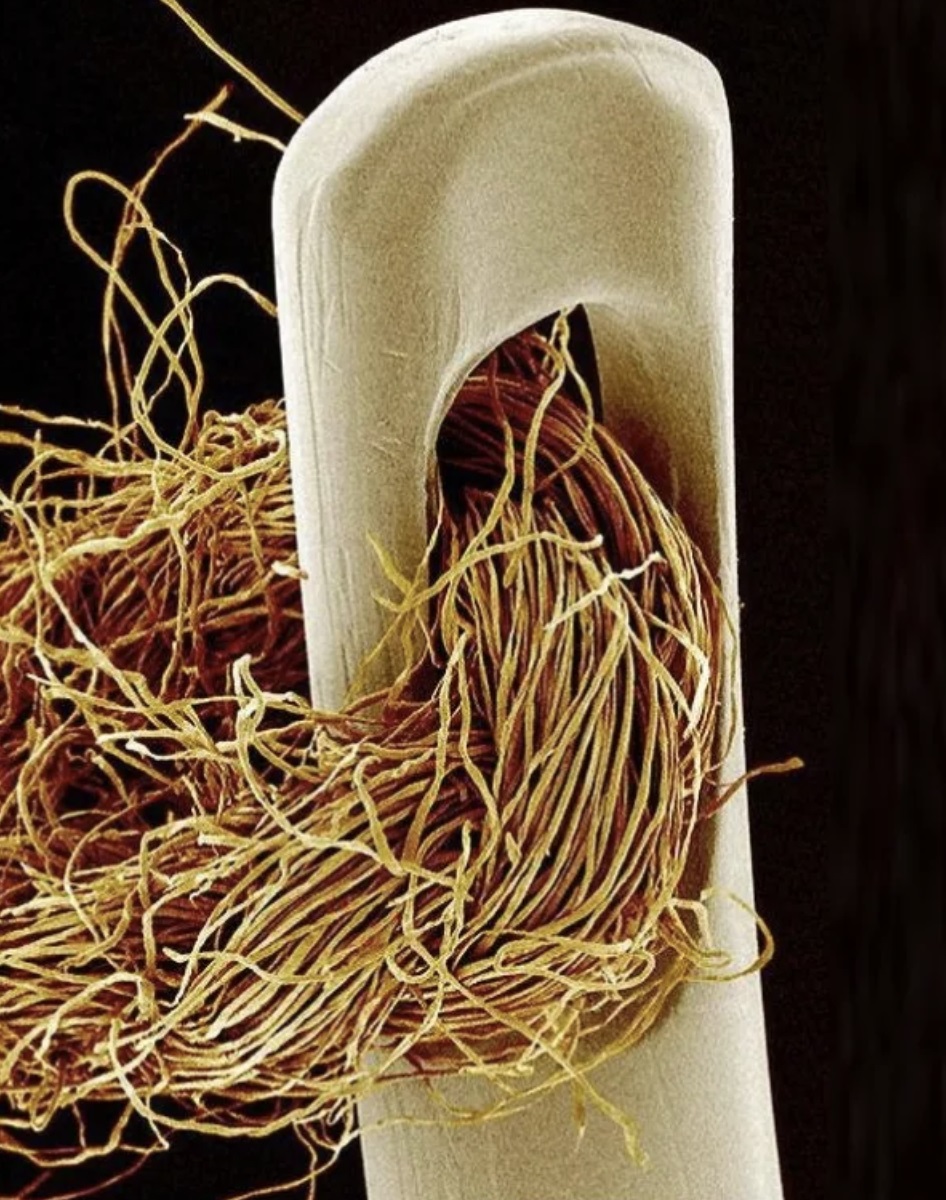 The Golden Thread of Jesus’ teaching is many separate strands woven together, each with its own shade and lustre which together make the thread as strong and as golden as it is. A photograph of a golden thread seen through an electron microscope as it is passed through the eye of a needle shows clearly that the thread we thought was a single strand is in fact made up of many finer strands. (no wonder it is difficult to thread a needle!)
 The Way of Jesus and Twelve Step Recovery