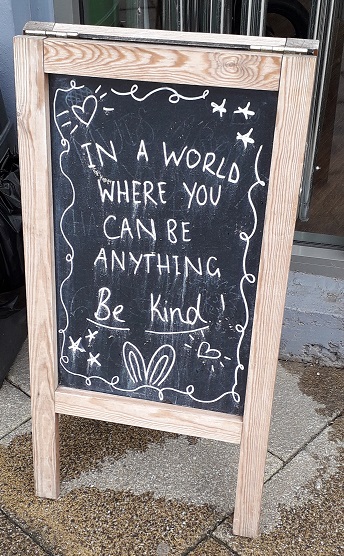
Compassion 2

I’ve been thinking a lot about compassion recently. It’s something I’ve written about before, but the last six months have given me much more direct experience than I had previously. Having been on the wrong side of a cancer diagnosis in early summer, I’ve received a lot of kindness, help, sympathy and understanding, all tangible displays of love and support. But there have also been a number of people who have shown me immense compassion. They’ve offered a solidarity which has touched, strengthened and healed me in a much deeper way than anything else.

There are seventy-seven uses of the word “Compassion” in English versions of the Bible. Incredibly seventy-six of these are about the compassion of God (or God in Jesus), the only exception being in the parable of the Prodigal Son where the Father had compassion for his lost (prodigal son). And of course, in that story the Father’s response is a picture of God. So, the only uses of the word compassion in the Bible are about the nature of God.

What then is compassion? It seems to me that it differs from sympathy, pity, empathy, concern or assistance because it’s not just about reaching out and doing for someone, but about a complete identification with them and their situation. As Thich Nhat Hanh says, “When we can free ourselves from the idea of separateness, we have compassion, we have understanding, and we have the energy we need to help.” This was the essence of Jesus’s ministry. He identified with the suffering of human beings, especially those on the edges of society, so often defined as unworthy by the seemingly good and acceptable religious community, and he stood alongside the people who suffered. Not as a token of how caring he was, which we can sometimes do in our relationships with those in trouble or need, but as a sign of his oneness with them. He became one with us as he was one with God. It is a willing relationship of equals. There is no power dynamic involved – it’s not about someone being sorry for us and helping us – it is a response of the heart not the mind.

I don’t know if we can cultivate compassion in and of ourselves, but it is the essence of God, so it’s something that every single one of us can be given and receive if we desire it. It does not come without a price though, as the life and death of Jesus showed. His oneness with those in need brought a rejection by the establishment and all their lackies who knowingly or blindly bought into the false reward system they peddled. Ultimately as we know, the compassion of Jesus was something which cost him his life.

There is a good deal of compassion in 12 step programmes.  This is not particularly evident amongst active addicts – they may hang out together, but they’re not a unity. It only comes when addicts start to get well by working the programme, which rather than giving them an elevated sense of superiority over the active addict, actually creates a greater sense of one-ness. The programme works in a way which keeps people grounded, recognising the on-going similarity and unity between the active and recovering addict. As Eckhart Tolle says, “Compassion arises when you recognize that all are suffering from the same sickness of the mind, some more acutely than others.” We’re broken and remain broken, lost and without a hope, desperately in need of acceptance and forgiveness but by the grace, mercy and above all compassion of God, we are saved from ourselves and in oneness with each other come to the party, the feast that is given by God.

The Compassion of Christ

Christ is the one who sides with the addict,

Bears the bruises of the beaten wife,

Knows the cold and misery of the homeless,

Surrenders to the loss of control and fears of the person with dementia,

Shares the powerlessness of the little child,

Experiences the isolation and stigma of the mentally ill,

The hopelessness and confusion of those with long covid,

Accepts the shame and humiliation of the poor,

Carries the shackles of the slave,

Grieves with the bereaved,

Suffers the rejection and abandonment of the asylum seeker,

And offers his arms to take the poisons of chemotherapy.

Christ is for ever one with us and for us, in all our adversity and pain.

May we share his compassion with all those we meet on our journey through life.
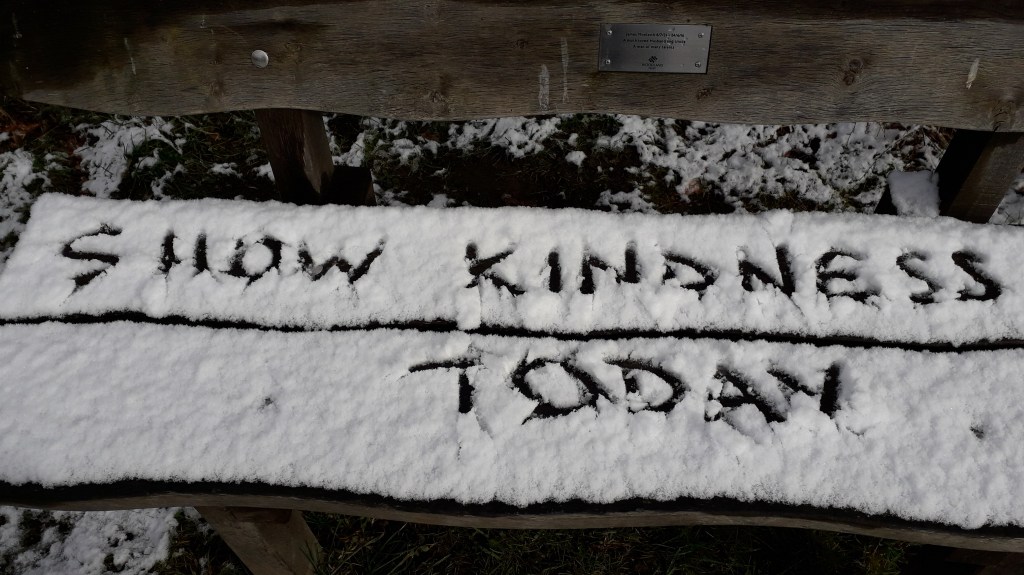
Kindness

The other day I was walking along the street behind a young boy wearing a brown hoodie. He held his mother’s hand, and they were chatting away to one another as they walked. On the back of his top, in large cream-coloured letters it said, “Be Strong, Be Courageous, Always Be Kind and have Fun.” They were walking quite slowly and as I overtook them, I said to the boy, “I like the words on your top, that’s a good way to live your life.” He was too shy to reply, but his mother beamed at me and said, “Thank you so much. He chose it himself.” She was right to be proud of him.

When so much in the world seems bleak and unpromising, it is a sign of hope that children can recognise the importance of kindness. His hoodie has continued to make me think more widely about what kindness means and how we can try to build it into our lives (along with strength, courage and fun!).

According to one dictionary definition, kindness is the quality of being generous, helpful and caring about other people. It’s more than just being nice, there is an element of intentionality – another person has thought through what might help us and perhaps even gone out of their way or inconvenienced themselves by their act of kindness. They’ve put us before themselves.

What is so interesting about kindness is that when we are the recipients of a kind act, it doesn’t just help us in our predicament or at least make us feel valued, it can stir something within us which makes us want to be kind too. It is not about pay-back or settling a debt, some new good thing has been ignited at a deeper spiritual level. We want to pass it on to someone else by being kind to them in turn, the first ripple of a new movement or flow of kindness. It’s not just about doing acts of kindness either, we need to speak about acts of kindness we witness too, rippling the effects more widely afield. As Amelia Earhart puts it, rather more poetically “A single act of kindness throws out roots in all directions, and the roots spring up and make new trees.”

Kindness is the outworking of loving our neighbour as ourselves, which Jesus spoke of as the second great commandment. Jesus is constantly referred to as showing compassion to people he meets and to all those with great need whom he healed, taught and fed. His stories too were often about the importance of showing kindness, compassion and generosity to others – the good Samaritan, the parable of the sheep and goats, the lost sheep, and when he received an act of great kindness from a repentant woman who poured expensive perfume on him, he predicted that her story would be told for ever.

Kindness is central to all twelve-step recovery. In meetings newcomers are welcomed and shown complete acceptance, the primary purpose according to the fifth tradition of AA being to carry their message to the alcoholic who still suffers. This requires kindness, which becomes an important way of helping us to stop being so self-absorbed, to look beyond ourselves. That’s how our own healing and recovery come about. If we are thinking about other people, which requires some imagination, empathy and most important of all, action, then we are taking time out from just thinking about ourselves. There is always the need for balance though. As addicts we tend to do everything to excess, so being kind and gentle with ourselves is also important.

Acts of kindness are unilateral and radical. In a world where so much isn’t in our control, we have complete license to do acts of kindness, to pretty much whoever we want, whenever we want to do them. It doesn’t require anything in the way of resources either apart from a willingness to make ourselves vulnerable and put the needs of others before our own wants. The author Og Mandino’s words inspire us to action. “Beginning today, treat everyone you meet as if they were going to be dead by midnight. Extend to them all the care, kindness and understanding you can muster, and do it with no thought of any reward. Your life will never be the same again.”

An Advent Reflection

Whilst searching online for an unusual Christmas present for my brother I was struck by the number of websites offering me a memorable “experience”. There seems to be something for everyone, whether that is bungee jumping, afternoon tea, a flight in a hot air balloon or gin making. There is nothing intrinsically wrong with any of these activities but looking at them as a drop-down menu conveyed a rather desperate sense of how far we have all drifted from a pathway of spiritual wellness. In the first world at least, where materialism rules, we desperately fill our lives with possessions, the newest things and latest models, the next labour-saving device, the most amazing experience ever. All of this is just another form of addiction. We numb the pain, fill the void and cope by consumption of goods and experiences hoping that somehow this will leave us fulfilled and whole. But it leaves us hungrier than ever, looking for the next fix.

God and spiritual growth cannot be bought on Amazon nor are they to be found on a Virgin Experiences website. Neither for that matter are they to be found in other sorts of drugs or material experiences. We grow by letting go, by giving away and by emptying ourselves to allow room for God to work. As we have waited through the weeks of advent, we remember Mary, the expectant mother of Jesus who is the exemplar of this. “Let it be to me according to your will,” was her response. By letting go of her own plans or desires and embracing a far bigger picture, one in which God was pleased to dwell, everything became possible. Through her we are all blessed. The pathway for us is the same. We may not be remembered by future generations as she is, but the response is the same. As the saying in recovery goes, let go and let God.

What is Gratitude?

The question, once asked,

lay heavy with uncertainty

about the answers it might bring.

Yet they came quickly and willingly

the nine-fold response

painting a clear picture,

defined in large, bold, brush strokes

as love and faith in action

and a recognition

that we are all blessed

if only we take the time to look.

Sometimes though, gratitude appears

as a benevolent mugger

catching us unawares,

giving gifts

instead of taking from us.

But mostly, gratitude is found

when we choose to seek her out,

our upturned faces taking time to recognise

her quiet and gentle presence

in the radiant glory of the morning,

a brief moment during the day or

the velvet stillness of the night.

Through journaling

quiet introspection, prayer

and honest examination

we see her shape and features.

But the most vivid colours  

of the artists palettes

appear in the finer detail.

No longer an abstract painting

or identikit, it becomes a true likeness,

a portrait that we all recognise –

walks on a wide golden beach,

safe landing at the airport,

a movie to watch,

cream-scones,

fresh water,

snowdrops,

music.

All five senses

alive to the abundance

of the riches around us.

Swimming in the river,

a good book to read,

a hot steaming bath,

the warming energy of sunshine,

or perhaps a cosy chair

in front of a glowing winter fire.

Good education, modern medicine,

the sound of children playing,

red kites gliding overhead,

the smell of the earth after rain

or wild garlic in the woods.

Writing songs, stories and poetry,

knitting (and finishing) a scarf,

the first sign of seedlings,

a fine supper prepared

from random leftovers.

Fashioning clay and wood,

their textures and smells

enriching the experience,

deepening the satisfaction

of creating something

where once there was

raw nothingness.

What is gratitude I asked,

both curious and uncertain,

and in reply you painted a portrait

of beauty.

I asked nine friends to tell me what gratitude means to them. Some work a twelve-step programme, others follow in the way of Jesus, some do both and others neither. This this poem weaves together their many answers – definitions of gratitude, how to be more aware of it and the things they are grateful for. Many thanks to all of them for so willingly sharing their ideas and experiences.

Competition or Co-operation?

“I’m really grateful for one thing,” my brother said, “Dad taught us to be competitive and go in hard.” We were talking about my father and our upbringing, not long after his death. Even if this statement about him was true outside of the board games we used to play, his contribution was still only a small part of the big lie we are all told many times over, that life is about competing with other people and it pays to be ruthless in doing so. It is only in recent years that I have begun to see this lie for what it is, although changing the way I live is taking a whole lot longer.

From the start I want it to be clear that I’m not talking about winning at school sports, a game of monopoly or pool or even getting a job or wanting the football team you follow to win every match. Neither am I suggesting that wanting to achieve and excel at the things we do as individuals and in groups is wrong. What I am doing is kicking back against idea that absolutely everything in life is about competition and that this is an inevitable part of the evolutionary process. In other words, the notion that we are hard-wired to be competitive and competition is just another way of describing the survival of the fittest. Really? So the rush to get a seat on a crowded train or to be at the front of the dash into a store on the first day of the sales or to stockpile sugar, pasta, or flour is simply our need to provide for ourselves and those we care for? Even if there is a grain of truth in this, it quickly becomes a very unhealthy belief system to operate by, because the reality is that if I get what I want, this invariable results in someone else having less – no seat on the train, empty supermarket shelves and so on. The idea of competition and its alleged evolutionary source can so easily be an excuse or rationalisation for our selfish, greedy behaviour. What’s true for individuals is true for nations too. The current UK government has recently cut its overseas aid budget because it says the UK needs those resources more than other much poorer countries. When it’s got much richer, it will increase its aid budget again. Indeed.

Self-interest dressed up as competition could be seen in the subsistence farming economy of Jesus’s time – if a person accumulated crops in his barn and needed to build bigger barns to hold the grain then it was at the expense of others who had little or went without. No wonder Jesus’s parables often touched on this important area of life. His teachings suggest that we are meant to be in co-operation with God and with one another, not in competition, because there is plenty to go around. As beings created in God’s image, we have rationality and moral principles as our guide, not just survival and reproduction instincts. The early church at least was very much a community which had sharing and caring as its hallmark, following in the way of Jesus. It’s also a key element of recovery –we even talk about the recovery community. It’s not a competition about whose recovery is better or who is a better follower of Jesus.  In the latter case we are all poor at it and the whole point about grace and mercy is that they are freely given to all of us, not just those who earn it or achieve a certain level of merit. And how do we respond to this grace? We serve one another, as Jesus taught us to do and showed in his life as a Servant Leader.

I always remember being moved by the slightly corny yet profound school assembly story of heaven and hell. Both were places with plenty of food but people could only eat using six-foot-long spoons. In hell everyone went hungry because they could not get the food into their mouths but in heaven everyone was full because they fed each other. In 12 step recovery this idea of working together and being non-competitive is perfectly illustrated by the complete absence of hierarchy and positions of status. The emphasis on service is very strong – again the model of Jesus as servant leader, and his counter-intuitive message that to become great we must become the least and the servant of all.

Pushing ourselves and having a competitive spirit isn’t a bad thing but the real lie is that this is what defines us as people. It’s even been said that extreme acts of heroism or altruism are really just self-serving actions, a cynical view of someone’s self-sacrificial act of giving and love for another. Love is what make us truly human and that is what both Jesus’ teachings and 12 step recovery are both about – making us more fully who we are meant to be and less the isolated, fearful, addicted people that the competitive world creates and fuels.

Christmas is a reminder that Immanuel is God with us, not God against us or watching us or even letting us sort it out for ourselves. God is with us, co-operating, working together to make the Kingdom of God a reality, not just seasonal bonhomie but good will to all, now and always.

The Mystery of Spiritual Growth

It was a warm afternoon in June. I was on a Zoom call and we were already an hour into a Steering Group Meeting when the agenda moved on to Item Eight – Key Performance Indicators. I groaned inwardly. Never a subject for the fainthearted, especially on a sunny Friday afternoon, setting KPIs and agreeing outputs and outcomes for projects involving people can be like buying something from a souk. A lot of haggling with no certainty as to what the product really is or what numbers to come up with. KPIs are a useful business tool and for some years now have also been an important requirement of many charity funders, but we were discussing a new project about spiritual nurture and growth for those on the margins – how do you develop a performance measure for that? As Albert Einstein remarked, “Not everything that counts can be counted and not everything that can be counted counts.”

Drifting off into a brief flight of fancy, I began wondering what exactly Jesus had in mind at the start of his ministry – a new spiritual project if ever there was one. What would the KPIs or planned outputs and outcomes have been like?

  • The programme will be of three years duration
  • It will be self-funded – the lead will be responsible for finding supporters to maintain the programme to ensure long-term sustainability
  • Twelve volunteers will be taught and mentored as disciples to lead the programme
  • At least 90% of these disciples will complete the programme and continue to deliver after the lead has left
  • 50% of those hearing the message will feel that their life has improved as a result

Of course, it was nothing like this. What Jesus did say was that “the Spirit blows where it will” and his measure of success was not about numbers or impressive outputs but about announcing the arrival of the Kingdom of God and signposting people towards it. This Kingdom was likened to yeast or the growth of a seed – slow, steady and secretive. We know too from Jesus’s parable of the sower, that even when the seed does grow, its development into a fruit bearing plant is far from guaranteed. The outputs and outcomes are never certain and always varied. Elsewhere, in a story in which Jesus healed ten lepers, only one of them subsequently bothered to return to thank him – few funders or commissioners would be happy with a 10% outcome on “follow-up” conversations! 

Looking at the style of Jesus’s ministry, it’s surprising to see so many in the Church obsessed by the numbers game. Perhaps we’ve bought into the KPI business model too wholeheartedly, wanting to appear dynamic and aspirational for our mission, or maybe numbers are seen as a proxy measure of success and an expectation that more people equals increased income for the church –neither of which were concerns for Jesus.

The origin of the spiritually based Twelve Step Programmes of Recovery is mainly Christian and unsurprisingly they don’t tend to deliver predictable, defined numbers either. “Show us your evidence base” is the current mantra of Addiction Treatment Commissioners in the UK, yet people were getting well and recovering by working the Twelve Step Programme long before there was any other formal alcohol treatment available and when there was, some early efforts involved giving alcoholics doses of LSD! Twelve Step Recovery is not predictable, but as we’ve already seen, if the Spirit blows where it wills, why would a spiritual programme of recovery be easy to predict? God’s work always retains some element of mystery. As a manager of a Twelve Step Treatment Centre once said to me, “We do all the standard assessments about motivation and suitability for our programme, but in the end, we really don’t know who will recover and who won’t. If someone wants to change, then that’s good enough for us to start with.”

Millions of people bear testimony to the fact that they have become sober and their lives have been transformed by working a 12 step programme, arguably one of the greatest public health developments of the last century and because it is a spiritual programme, one of the most profound revival programmes too. Central to one of the 12 Traditions of AA is that notion that the message of recovery is conveyed by “attraction not promotion,” in other words, seeing the transformation in the lives of real people, not through a page full of promotional outcomes and statistics. We see this transformation in the lives and writings of Christians in recovery such as Brennan Manning, Nadia Bolz Weber, Heather King, Ian Morgan Cron and Anne Lamott who have a spiritual integrity which is deeply attractive because their faith and view of the world and themselves is brutally honest yet gentle, speaking truthfully to the reader’s own life and always pointing them to a God of immense love who is in the business of redemption and transformation.

We are all on a journey of the Spirit whether it is upstairs in the Chancel on a Sunday morning or downstairs in the Basement on a weekday evening at a Twelve Step meeting. God is there in the midst of our brokenness, meeting us with arms outstretched to bring us home. We are fellow pilgrims and travel together on our journey to this holy place. Measure that if you will.

An Inside Job

I love browsing in flea markets and junk shops. You just never know when there may be something of value hidden in the midst of all the tat and rubbish. It’s kind of ironic, really, because over recent years I’ve come to realise that my inner life also contains a great deal of clutter and trash. I may try to convince myself or others that it is a tidy, well organised place, full of unique pieces – interesting curios and charming antiques if you like, but unfortunately, it’s not really like that. Inside, there’s the cluttered rubbish of a junk shop – wrong ways of thinking, distorted memories and beliefs, long held resentments and unhelpful patterns of behaviour. I suspect too that I’m not alone in this if conversations with a few close friends or comments that I’ve read are anything to go by. As the author CS Lewis said, “on looking inside myself I found a zoo of lusts, a bedlam of ambitions, a nursery of fears and a harem of fondled hatreds.”

Jesus was well aware of our inner mess and was never fooled by those who were presenting themselves as neat and well-ordered. He responded in different ways. To the scribes and pharisees, self-righteous and proud, he was scathing: “Hypocrites! You are like whitewashed tombs, which outwardly appear beautiful, but within are full of dead people’s bones and all uncleanness.” On other occasions he was more sensitive, though just as clear about the problem. For example, when a rich man came to him asking what he needed to do to inherit eternal life, Jesus was gentle in his response when the man said that he had kept all the commandments since he was a boy. Jesus told him to go and sell all that he possessed, which got to the heart of the man’s inner problem – his wealth was a false source of security, an idol in the place of God, sadly too much for him to let go of at that point in his life. On yet another occasion Jesus spelt it out for us all when he said that “What comes out of a person is what defiles them. For it is from within, out of a person’s heart, that evil thoughts come.”

Twelve step recovery is also very clear about our inner mess, and it is probably fair to say that the bulk of the programme is about addressing this mess rather than the specific addiction. There is a clear recognition that it is the accumulated rubbish in our lives which not only pushes us towards addiction but keeps us there and creates wrong ways of living. This may be a result of things done to us, traumas suffered even, or it may be a consequence of incorrect ways of coping with the ups and downs of life, bad decisions we’ve made and wrong actions on our part. Whatever the cause, the result is the same and dealing with our inner mess is the stuff of almost half of the twelve steps, beginning with Step Four’s “searching and fearless moral inventory of ourselves,” followed up in quick succession by the next two steps where we admit to “God, ourselves and another human being the exact nature of our wrongs,” moving on to a point where we are “entirely ready to have God remove all these defects of character.” It is a way of living which deals with the rubbish in our lives that many of us would prefer to bury away from the scrutiny of others.

Because it’s an inside job, we must reply upon and co-operate with God, our Higher Power to do this work within us. Prayer and meditation is the central, golden thread through which we seek knowledge of God’s will for us and the power to carry it out. This is of course not a one-off event but a daily practice, which ultimately becomes a lifelong way of living. It’s not a solo flight either. We don’t have to do it alone – in fact we were never meant to. We need others to help us, through confession, spiritual direction, sponsorship, discipling, mentoring or even just plain, honest conversations and sharing over a cup of coffee.

Unlike Twelve Step Recovery, much of Christianity has now become a private faith, something that is just between ourselves and God, but when we do involve others and share something about our inner junk – our “dead bones and uncleanness” – we begin to find freedom and healing. This is helped by the fact that we not only find an acceptance from the other person about this part of ourselves and the things we have done/think which shame us, but invariably an acknowledgement by them that they are pretty much the same. We are not alone.

As jobs go, inner change is a slow business. At times it can be disheartening, because once we are aware of our inner mess, we tend to continue to notice the junk more than anything else. “All you can do is create a space for transformation to happen, for grace and love to enter,” says Ekhart Tolle.  When we do, these mysterious currents of God’s Spirit get to work within us, highlighting our beautiful and valuable inner treasures to other people who are helped and blessed by them, even if we aren’t aware of it. Miraculously, when we change, the world changes a little bit too.

A Morning Prayer

Someone recently showed me a powerful quotation – the sort which stops you in your tracks. It went thus: “Christianity is a lifestyle – a way of being in the world that is simple, non-violent, shared and loving. Unfortunately, we made it into an established “religion” (and all that goes with that) and avoided the lifestyle change itself.” This stunning critique by the Franciscan priest and author Richard Rohr seems to get to the heart of why we Christians have so often failed to transform society as Jesus intended. If, by the way, you’re about to question that, go read the Sermon on the Mount first and see the manifesto for lifestyle change which Jesus proposed. It’s radical stuff. Not just The Beatitudes (which themselves are a call to new and positive action), but the subsequent teachings about loving our enemies, giving to the needy, forgiving those who wrong us, not judging others and living a day at a time, trusting in God’s daily provision for us.

Twelve step programmes of recovery are also about lifestyle change. Yes, they’re about stopping an addiction, but ultimately, they’re about living a happy, joyous and fulfilled life by behaving in a totally different way, one day at a time. The Big Book of AA (p84) describes the process in detail. “We continue to watch for selfishness, dishonesty, resentment and fear.  When they crop up, we ask God at once to remove them. We discuss them with someone immediately and make amends quickly if we have harmed anyone.  Then we resolutely turn our thoughts to someone we can help. Love and tolerance of others is our code.”  As one of the sayings within recovery puts it, “You can’t think yourself into a new way of living, you have to live your way into a new way of thinking.”

One of the best ways any of us can do this, is to start each morning with a prayer, committing ourselves afresh to this different way of living and asking for help to carry it out. For those in recovery this is Step 11 work (“Sought through prayer and meditation to improve our conscious contact with the God of our understanding”), which is probably the most easily neglected or side-stepped part of the programme. There are of course countless prayers we can use but here is a simple one which helps me to begin each day with fresh resolve to live it well and live it in the right way.

Searching for Soul Food

The strawberries I’ve eaten this summer have been a big disappointment. Though bright red and as beautiful looking as ever, they taste weak and watery, not delivering that massive hit of flavour which should leave you reaching for the next berry, the one after that and so on, a conveyor belt of pure strawberry pleasure.

It reminds me of my experiences attending church. I usually go with great expectations, but if I’m honest, services generally don’t hit the sweet spot I’d hoped for. It doesn’t really matter how hard I try or what style of service it is either, other people around me always seem to be getting a lot more out of it than I do, as if their bowls of strawberries are packed with flavour, whilst mine is not. Some of these people appear to be in a state of ecstatic rapture, some exude an aura of quiet holiness, others have the intense look of desert hermits but unfortunately, I’m not as transfixed. It’s not the fault of those leading or taking part in the services and I have the best of intentions, genuinely wanting something profound to happen, but invariably I end up distracted by a wandering mind or I’m just plain bored. Inevitably I feel rather shallow and unspiritual as a result, but somehow, inexorably, I’m drawn back, week after week.

I was helped enormously with this problem by a friend in Twelve Step Recovery who talked to me in passing about an AA meeting he’d just attended. “It was awful,” he said. “I wanted to walk out, listening to some of the ridiculous stuff that was being said.” This intrigued me because neither he nor anybody else I know who attends meetings had ever said anything like that to me before. My friends in recovery are all wise, honest, perceptive people and I imagined the meetings they attended would be full of sassy folk like them, pouring out words of understanding and insight from loving hearts. I probed, wanting to find out more. He laughed at my naivety. “You’ve been to meetings,” he said. “You know its not all love and enlightenment. A lot is quite boring and there’s a fair bit of unchallenged nonsense spoken too. Whatever my feelings may be though, I stick around and continue to turn up at the meetings because it’s all I’ve got, and somehow the five percent that’s really good helps me to stay clean and sober.”

I thought about my church-going experiences. The parts which pass me by or I miss through not concentrating and mentally drifting off certainly aren’t nonsense, but perhaps it’s okay for me to stop worrying about them. Maybe there’s never going to be an earthquake, wind and fire, or at least, until there is, why not concentrate instead on listening for the still small voice in the five percent that does do something for me. On the days when I can’t even get as high as five percent, I need to remember that always, always I come away feeling better in mind and spirit than when I arrived. Something happens deep within. The still small voice may not be audible, but I’m reminded that I am connected, part of a motley shoal of people that is swimming against the prevailing current. I get fed with tiny morsels of spiritual micro-protein and wisdom. I recognise the need to be still and to receive God’s love whether that is through sharing the Peace, receiving the Eucharist or conversations over coffee afterwards.  Jesus said “I am the Bread of Life. Whoever comes to me will never be hungry.” I know that I’m hungry and need food from the table, provided by the Bread of Life, so I’ll just keep on turning up to receive this in any way I can and in any place where I find it. As they say in Twelve Step meetings, “Keep coming back, it works if you work it.”

On the Frontline – learning from Covid

It now feels like a very long time ago that Coronavirus so rudely kicked down the front doors of our comfortable, stable, well-planned lives and unceremoniously marched on in.  At long last, nearly eighteen months later, many of the worst affected countries are finally lifting their lockdowns and easing the various restrictions put in place to limit the virus’s rapid and seemingly relentless spread. It is noticeable, however that this gradual relaxation has been accompanied by signs of the usual human tendency to forget what we’ve been through and the lessons we thought that we’d learned, as we rush headlong to bury ourselves once again in what Heather King calls “the low-level anaesthetic haze of distractions and false gods.” There’s an old Irish blessing which says, “May you never forget what is worth remembering, nor ever remember what is best forgotten.” Maybe now is a good time for us to take stock and reflect on the things that we thought we’d learned during the Covid Pandemic but are now in danger of forgetting. We need to remember what is worth remembering.

Over the first six months of the pandemic there was a lot of talk about both love and suffering. Love was perhaps most clearly seen in the work of many of the frontline health and social care staff whose self-sacrificing care for the ill, lonely and dying went far beyond their job descriptions or professional expectations. Other essential workers, all too often the lowest paid people in our communities served us with immense dedication and love, keeping shelves stocked, food supplied, garbage cleared, fuel flowing and transport running. With schools and workplaces shut, families suddenly found themselves living close to one another 24/7 which required them to discover new depths of love, patience and tolerance. Love was also to be seen in many small acts of kindness for others in need in the community. People looked out for neighbours who were old or vulnerable, significant increases were seen in donations and contributions to local food banks and meal services, help was offered to those who could not manage. Little kindnesses of many sorts abounded. We discovered the truth of Mother Theresa’s words: “Not all of us can do great things. But we can do small things with great love.” Communities flourished and we dreamed of a greener, cleaner, more loving world.

The virus also caused much suffering too. Not just the premature and often painful death of nearly four million people world-wide, but also those who were acutely ill and survived, as well as relatives who suffered as their loved ones died alone and without the opportunity to say a final goodbye. Those who have developed ‘long-covid’ continue to suffer in painful and extreme ways.  Elsewhere, many people with other health conditions suffered from temporarily inferior services and slower treatment as resources were shifted to fighting the virus. And all around us the poor, those in overcrowded living conditions, those in households where there was domestic violence, suffered even more than normal. Some experienced a double or triple whammy of these and other sources of suffering.

The majority of us, may not have experienced such extremes and instead found ourselves stuck in the lockdown hinterland of reduced options, dull routines and loss of purpose as its duration dragged on beyond any of our expectations. We just longed to get back to normal, whatever that new normal would look like. Yet, our eyes had been opened to a global vulnerability, and maybe we’d never have quite the same self-assuredness ever again.

Love and suffering have always been the most significant means by which we achieve spiritual growth. People in recovery know this and Jesus taught and consistently lived this truth. Addiction itself causes “acute and constant” suffering to both the addict and those around them and arguably the turning point is when the prolonged suffering caused by the addiction becomes too great to carry on. As the book Twelve Steps and Twelve Traditions says, “Until now, our lives had been largely devoted to running from pain and problems. We fled from them as from a plague.  We never wanted to deal with the fact of suffering. Escape via the bottle was always our solution. Character-building through suffering might be alright for the saints, but it certainly didn’t appeal to us.”

The road to recovery is painful. The simple fact of living without a substance or process that we have always relied upon and having to stand without it, emotionally naked before the world is hard. Recovery is also painful because it requires change, most significantly the loss of ego which comes from our surrender. But wherever there is pain and suffering, love is usually there too, lurking in the shadows in the form of other people for whom this is a way of living and service. As the Big Book of AA says, “Love and tolerance of others is now our code.” In twelve step recovery, people find themselves drawn to others by acts of love; the duty which begin as a requirement of the programme ultimately develops into a way of life for the individual who gradually becomes loving and giving rather than selfish and taking.

The single most important message of Jesus was that God loves each of us and as a result will do anything to bring us back into his light. Anne Lamott says, “Sometimes I think God loves the ones who most desperately ache and are most desperately lost – his or her wildest, most messed-up children – the way you’d ache and love a screwed-up rebel daughter in juvenile hall.” The two great commandments of Jesus urge us to love the Lord God with all our heart, mind and strength and to love our neighbour as ourselves. No soft, sentimental love this, but a diamond hard centre of being, made so by the intense forces of costly self-sacrifice and suffering. As children of God we are to fill our lives with such love for God and others. Never one to ask anything of others that he did not do himself, Jesus lived this love to the full and experienced the process of dying to self. “Unless a grain of wheat falls into the ground and dies it cannot bear great fruit.” His brutal death brought great love and extreme suffering together in one final cataclysmic yet ultimately triumphant event.

None of this is news to most regular readers of this blog and certainly not to anyone with a strong recovery from addiction or Christian faith. One of the golden threads running through both is that love and suffering are our great teachers. But because we sometimes lose focus and our ego seeks to reassert itself from being in its rightful place and constantly tries to Edge God Out, it always pays to do a spiritual health check on how we’re doing, remembering that we so easily fall prey to self-deception. No time is better for doing this check than right now when things are starting to return to “normal.”

As I’ve said previously in these blog posts, I’m a real coward and will do my utmost to avoid pain and suffering if I can, but I am also a realist who knows it’s a fact of life and that somehow, at some point it will come knocking. In the meantime, whether suffering or not, we can always work at being better at loving others. So, the question is, each day, how can we better love those around us, not just by what we do but also by what we don’t do. Not saying the unkind, uncharitable things but only speaking words that encourage, build up and bring life. Giving the nicest and the best – not just the cheapest or most convenient, sharing the things we hold dear, sacrificing our time, comfort and ease. It’s the kind of love which has no price tag on it. Such love is steady and slow work, changing us without us ever knowing it’s happening. Life may sometimes feel dull or purposeless but the challenge to love those around us means that each day and in every situation, we are all called to be frontline workers. “Did I offer peace today? Did I bring a smile to someone’s face? Did I say words of healing? Did I let go of my anger and resentment? Did I forgive? Did I love? These are the real questions. I must trust that the little bit of love that I sow now will bear many fruits, here in this world and in the life to come.” (Henri Nouwen)