Compassion 2

I’ve been thinking a lot about compassion recently. It’s something I’ve written about before, but the last six months have given me much more direct experience than I had previously. Having been on the wrong side of a cancer diagnosis in early summer, I’ve received a lot of kindness, help, sympathy and understanding, all tangible displays of love and support. But there have also been a number of people who have shown me immense compassion. They’ve offered a solidarity which has touched, strengthened and healed me in a much deeper way than anything else.

There are seventy-seven uses of the word “Compassion” in English versions of the Bible. Incredibly seventy-six of these are about the compassion of God (or God in Jesus), the only exception being in the parable of the Prodigal Son where the Father had compassion for his lost (prodigal son). And of course, in that story the Father’s response is a picture of God. So, the only uses of the word compassion in the Bible are about the nature of God.

What then is compassion? It seems to me that it differs from sympathy, pity, empathy, concern or assistance because it’s not just about reaching out and doing for someone, but about a complete identification with them and their situation. As Thich Nhat Hanh says, “When we can free ourselves from the idea of separateness, we have compassion, we have understanding, and we have the energy we need to help.” This was the essence of Jesus’s ministry. He identified with the suffering of human beings, especially those on the edges of society, so often defined as unworthy by the seemingly good and acceptable religious community, and he stood alongside the people who suffered. Not as a token of how caring he was, which we can sometimes do in our relationships with those in trouble or need, but as a sign of his oneness with them. He became one with us as he was one with God. It is a willing relationship of equals. There is no power dynamic involved – it’s not about someone being sorry for us and helping us – it is a response of the heart not the mind.

I don’t know if we can cultivate compassion in and of ourselves, but it is the essence of God, so it’s something that every single one of us can be given and receive if we desire it. It does not come without a price though, as the life and death of Jesus showed. His oneness with those in need brought a rejection by the establishment and all their lackies who knowingly or blindly bought into the false reward system they peddled. Ultimately as we know, the compassion of Jesus was something which cost him his life.

There is a good deal of compassion in 12 step programmes.  This is not particularly evident amongst active addicts – they may hang out together, but they’re not a unity. It only comes when addicts start to get well by working the programme, which rather than giving them an elevated sense of superiority over the active addict, actually creates a greater sense of one-ness. The programme works in a way which keeps people grounded, recognising the on-going similarity and unity between the active and recovering addict. As Eckhart Tolle says, “Compassion arises when you recognize that all are suffering from the same sickness of the mind, some more acutely than others.” We’re broken and remain broken, lost and without a hope, desperately in need of acceptance and forgiveness but by the grace, mercy and above all compassion of God, we are saved from ourselves and in oneness with each other come to the party, the feast that is given by God.

The Compassion of Christ

Christ is the one who sides with the addict,

Bears the bruises of the beaten wife,

Knows the cold and misery of the homeless,

Surrenders to the loss of control and fears of the person with dementia,

Shares the powerlessness of the little child,

Experiences the isolation and stigma of the mentally ill,

The hopelessness and confusion of those with long covid,

Accepts the shame and humiliation of the poor,

Carries the shackles of the slave,

Grieves with the bereaved,

Suffers the rejection and abandonment of the asylum seeker,

And offers his arms to take the poisons of chemotherapy.

Christ is for ever one with us and for us, in all our adversity and pain.

May we share his compassion with all those we meet on our journey through life.
Kindness

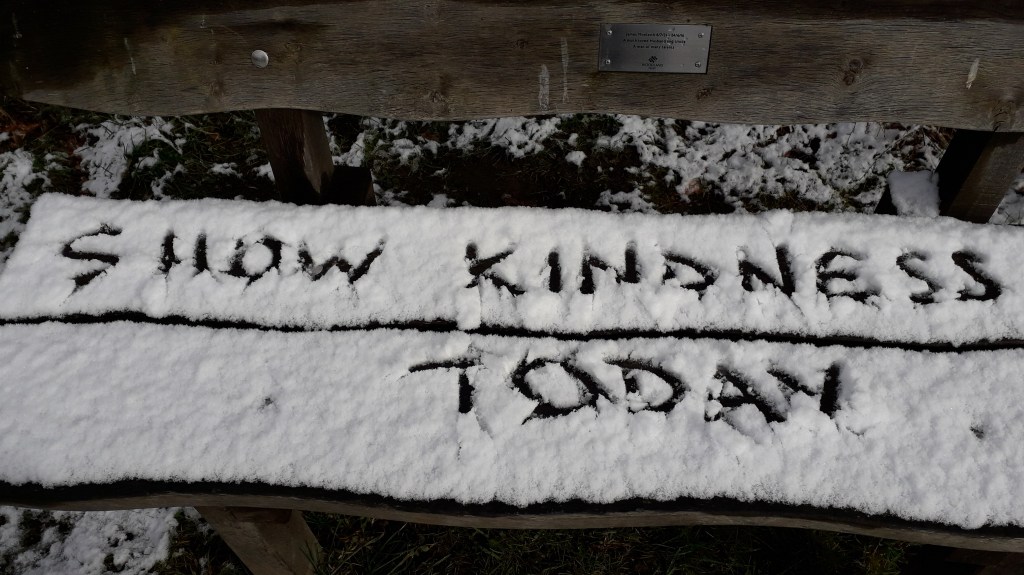
The other day I was walking along the street behind a young boy wearing a brown hoodie. He held his mother’s hand, and they were chatting away to one another as they walked. On the back of his top, in large cream-coloured letters it said, “Be Strong, Be Courageous, Always Be Kind and have Fun.” They were walking quite slowly and as I overtook them, I said to the boy, “I like the words on your top, that’s a good way to live your life.” He was too shy to reply, but his mother beamed at me and said, “Thank you so much. He chose it himself.” She was right to be proud of him.

When so much in the world seems bleak and unpromising, it is a sign of hope that children can recognise the importance of kindness. His hoodie has continued to make me think more widely about what kindness means and how we can try to build it into our lives (along with strength, courage and fun!).

According to one dictionary definition, kindness is the quality of being generous, helpful and caring about other people. It’s more than just being nice, there is an element of intentionality – another person has thought through what might help us and perhaps even gone out of their way or inconvenienced themselves by their act of kindness. They’ve put us before themselves.

What is so interesting about kindness is that when we are the recipients of a kind act, it doesn’t just help us in our predicament or at least make us feel valued, it can stir something within us which makes us want to be kind too. It is not about pay-back or settling a debt, some new good thing has been ignited at a deeper spiritual level. We want to pass it on to someone else by being kind to them in turn, the first ripple of a new movement or flow of kindness. It’s not just about doing acts of kindness either, we need to speak about acts of kindness we witness too, rippling the effects more widely afield. As Amelia Earhart puts it, rather more poetically “A single act of kindness throws out roots in all directions, and the roots spring up and make new trees.”

Kindness is the outworking of loving our neighbour as ourselves, which Jesus spoke of as the second great commandment. Jesus is constantly referred to as showing compassion to people he meets and to all those with great need whom he healed, taught and fed. His stories too were often about the importance of showing kindness, compassion and generosity to others – the good Samaritan, the parable of the sheep and goats, the lost sheep, and when he received an act of great kindness from a repentant woman who poured expensive perfume on him, he predicted that her story would be told for ever.

Kindness is central to all twelve-step recovery. In meetings newcomers are welcomed and shown complete acceptance, the primary purpose according to the fifth tradition of AA being to carry their message to the alcoholic who still suffers. This requires kindness, which becomes an important way of helping us to stop being so self-absorbed, to look beyond ourselves. That’s how our own healing and recovery come about. If we are thinking about other people, which requires some imagination, empathy and most important of all, action, then we are taking time out from just thinking about ourselves. There is always the need for balance though. As addicts we tend to do everything to excess, so being kind and gentle with ourselves is also important.

Acts of kindness are unilateral and radical. In a world where so much isn’t in our control, we have complete license to do acts of kindness, to pretty much whoever we want, whenever we want to do them. It doesn’t require anything in the way of resources either apart from a willingness to make ourselves vulnerable and put the needs of others before our own wants. The author Og Mandino’s words inspire us to action. “Beginning today, treat everyone you meet as if they were going to be dead by midnight. Extend to them all the care, kindness and understanding you can muster, and do it with no thought of any reward. Your life will never be the same again.”

Easter People

On Easter Day, things have moved on from the last blog in which we remembered the path of suffering which Jesus trod in his final days. The betrayal and denial by friends who just hours before had shared supper together, his arrest, rigged trial and execution at the hands of the state and religious leaders, a downward pathway of powerlessness, suffering and pain, which he met with love, arms open wide. On Easter Day everything changes, because Jesus is alive.

The resurrection shows and establishes once and for all that love is triumphant. God was never absent and has been there throughout. Though the darkness was very real, the light has not been extinguished, and never will be. The Easter message of hope is that not only can we survive the downward path and the pain in our lives, but that through the love and presence of God we rise up and grow from the tragedies and failures of our imperfection. This is the story of addiction recovery. This is the story of those who follow the way of Jesus. This is our story.

So, as Pope John Paul II said, “Do not abandon yourselves to despair. We are Easter people and hallelujah is our song.” May the light of Christ, rising in glory banish all darkness from our hearts and minds.

Ring Out, Wild Bells

Ring out, wild bells, to the wild sky,
The flying cloud, the frosty light:
The year is dying in the night;
Ring out, wild bells, and let him die.

Ring out the old, ring in the new,
Ring, happy bells, across the snow:
The year is going, let him go;
Ring out the false, ring in the true.

Ring out the grief that saps the mind
For those that here we see no more;
Ring out the feud of rich and poor,
Ring in redress to all mankind.

Ring out a slowly dying cause,
And ancient forms of party strife;
Ring in the nobler modes of life,
With sweeter manners, purer laws.

Ring out the want, the care, the sin,
The faithless coldness of the times;
Ring out, ring out my mournful rhymes
But ring the fuller minstrel in.

Ring out false pride in place and blood,
The civic slander and the spite;
Ring in the love of truth and right,
Ring in the common love of good.

Ring out old shapes of foul disease;
Ring out the narrowing lust of gold;
Ring out the thousand wars of old,
Ring in the thousand years of peace.

Ring in the valiant man and free,
The larger heart, the kindlier hand;
Ring out the darkness of the land,
Ring in the Christ that is to be.

By Alfred Lord Tennyson

Hope at Christmas

This guest contribution is written by Revd Pauline Shelton

‘‘God wants us to know that God loved us before God even made us, and this love has never diminished and never will. Powerful truths written by Mother Julian of Norwich, a remarkable woman who lived around 750 years ago in Norwich, England at a time of plague, riots and war with France — some things never change! That’s what God wants us to know — love, love and more love.

Really? You may be thinking. Where have you been this last year? Don’t you realise how awful2022 has been? There’s war in Ukraine — and a madman in the Kremlin. In Pakistan, floods devastated a third of the land. In Somalia, drought threatens the lives of millions, whilst rising sea-levels threaten the very existence of small oceanic countries. And closer to home, we have Covid, avian flu, and ‘normal’ winter flu, not to mention strikes — while figures show that the gap between rich and poor in Britain is wider than ever. In 2021, the richest 10% of households owned 44% of all wealth, while the poorest 50% owned just 9%. Scandalous. And more and more people are driven to food banks and to desperation.

But I refuse to despair. I won’t give way to the prevailing discourse that all is just getting worse and worse, even though that is how it often feels. Why? Well, it’s summed up in a verse at the start of John’s Gospel – ‘The Word became flesh and lived among us’. The literal translation of that is, ‘The Word became flesh and pitched his tent among us’. Only the very poorest live in tents. Tents are rarely permanent homes. They offer very little protection from the weather, or from thieves. God chose not only to become human, but to live among us in a marginal and vulnerable place — in temporary accommodation, in a tent on the edge of society.

And that’s summed up in the word ‘incarnation’. Incarnation means this extraordinary truth that God becomes human. And though at Christmas we may bless a crib or sing carols about mangers, shepherds and angels, the hope that I want to share with you isn’t just about a massive baby-fest. It’s not just confined to Bethlehem, and winter snows, stars and stables, beautiful and moving though all of that is.

Incarnation is about a change in the very heart and mind of God. It is about God deciding no longer to remain distant from the vulnerable world, the mess and fears and muddle and disease of the flawed and fallible people created and loved by their Maker. Instead, incarnation is about God deciding to enter into the midst of our tensions, our political injustices, our poverty and need — to enter into solidarity with wonderful and broken humanity.

It’s as if God said, ‘What if . . .?’

What if, instead of staying within the boundlessness of eternity, I accept the limitations of time and space?

What if, rather than be a disembodied Spirit, I limit myself to the physical body and intellectual capacity of a human being?

What if I come to earth not as the super-gifted child of an aristocratic family, but am parented by people who have no status, no secure home?

What if, rather than being educated at an exclusive fee-paying school, I learn about life through 30 years of anonymity?

What if, instead of being Superman, I make myself vulnerable — vulnerable to pain, to prejudice, to slander, to disease, and to the loss of credibility because of what I say and who I mix with?

What if, instead of choosing elite graduates from Oxford, Cambridge or Ivy League Universities I pick my companions from a random group of tradespeople, unskilled workers, social misfits — and at least one who is totally untrustworthy?

What if, rather than repeating safe cliches as a tele-evangelist, or from the safety of the pulpit six feet above contradiction, I talk face-to-face with real people about the forgotten and disregarded truths about life, faith and social justice in ways that will make religious people so angry that they’ll plot to kill me?

What if all I say and do to save the world by my life, my love and my example leads to hatred and rejection? And what if, rather than returning to the safety of heaven, I accept death, crucifixion — a sentence reserved for those whose love, honesty and integrity are too much for the powers-that-be to bear?

And what if, when I am dead, I don’t stay lying down?

What if that is what Christmas is really all about? And what if we see again this Christmas that Jesus comes among us, not to fix everything as if by magic, but to be in total solidarity with us. To be with us in all the messiness of our lives. To be part of the joys of today and tomorrow — and a part of the tensions and anxieties too. Jesus comes to be part of those, and to show us a truer way of being human. The incarnation is God’s limitless love enfleshing that love into the form of a human being, Jesus the Christ. The one born as a baby who pitches his tent in our garden, our yard, our street, our lives — so that incarnation keeps on happening, love keeps on flowing down the ages, always abundant, always pouring from the very heart of God.

Our grief, our pains, our troubles, our addictions, our worries, our loneliness are not the end. Thanks to what starts at Christmas they can be the birth pains of something unspeakably better.

‘The Word became flesh and blood and pitched his tent among us.’

‘‘God wants us to know that God loved us before God even made us, and this love has never diminished and never will.’

May the life of the Christ-child given for this broken and beautiful world be born anew in us this Christmas and always.

With grateful thanks to Revd John Bell, Minister in The Church of Scotland and until recently a member of the Iona Community for his idea of the “What if..” within both Advent and Christmas.

Compassion

There’s a marked absence of compassion in UK government policy right now. Whether it’s in the heartless plan to send UK asylum seekers 4000 miles away to Rwanda for processing and residency or the progressive removal of mobility allowances from many disabled people, the tardy provision of visas for Ukrainian families fleeing warfare and violence or the lack of concern for the poor as fuel prices and the cost of living spirals upwards (two thirds of the British cabinet are millionaires), there is a coldness and disregard for those less fortunate who suffer. I suspect that this does not reflect the sentiments of the British people either, but like so much political rhetoric it’s dressed up as a necessary requirement for the times in which we live, peddling the lie that there’s not enough to go round.

I make no apology for this political introduction, because at Easter we have been reminded once again how political expediency works, with the unholy alliance of the Roman occupying forces, their puppet king and the Jewish religious leaders requiring the death of Jesus for daring to challenge what they stood for. His challenge was to offer an alternative way, where achievement, affluence and appearance were not the dominant values. Right at the heart of this alternative way of living is compassion; in the Kingdom of Heaven, loving God and loving others is supreme.

Compassion is central to Twelve Step recovery too, yet another shared hallmark which this blog seeks to highlight. Compassion means “to feel with,” usually in relation to feeling the suffering of somebody else and being moved by that suffering to do something to help them. We’ve talked about mercy in a previous blog (Mercy, Mercy), but compassion is different. Mercy implies some sort of power relationship and possibly the presence of wrong-doing or falling short. Compassion does not have this power dynamic at all – it is simply one human being to another. In the words of William Blake, “Mercy wears a human face, compassion a human heart.”

According to Jesus, compassion is the central quality of a life faithful to God. He tells us to “be compassionate as God is compassionate.” The idea of God being compassionate towards us is potentially life changing. We often think of God as harsh and judgmental possibly tempered by mercy, but compassion means he is alongside us, with a human heart. We are to model this behaviour, and Jesus, the visible image of the invisible God is our pattern or template. There are many instances of Jesus being filled with compassion for somebody – invariably this preceded him healing and restoring them. One of his greatest parables, The Good Samaritan showed us the compassionate behaviour of a traveller who belonged to a despised and outcast race who sees a fellow traveller who has been beaten and robbed and proceeds to rescue and care for him at his own expense. Prior to this the injured man had been ignored by high status people of his own country. In modern day terms, the politician and the priest have passed by with more important things to do, it is the refugee who shows compassion.

Compassion within 12 step recovery is perhaps understandable because every recovering addict has been there too, so can understand the pain and struggle another is going through, both in active addiction and early recovery. People working the programme enter the suffering of other addicts with neither pity nor pride and their caring is frequently both tireless and humbling. It is seen in the way newcomers are treated, which helps them to find a place of emotional warmth and understanding. It is there too in the welcome and acceptance each person receives when attending a new meeting in another place or country. Compassion is woven throughout the programme and is an important factor in the healing, transformational power it holds.

Like gratitude, humility or generosity we must practice compassion so that it becomes an established part of our daily living. The initial “feeling for” someone is often outside our control – we feel pity or sympathy for them without needing to generate it. What we must work at is the response, in which we then do something to help them. Our first reaction is to do something, but very quickly our mind (or other people) tell us it will be too difficult, too costly, too little or just plain misunderstood. We have to practice taking that step to make things better for the person we feel compassionate towards and ignoring the multitude of reasons we might find for not doing so. Remember how life changing it was for us when somebody helped us out of kindness and compassion?

As a friend of mine often reminds me, all of us are wounded, bandaged travellers on the road, sometimes wayward, often lost, invariably pretending that we are okay, but always, always in need of compassion, longing to be free, hungry for heaven. In the words of the Dalai Lama, “love and compassion are necessities, not luxuries. Without them, humanity cannot survive.”

On Logs and Street Sweeping

There are many wise and pithy sayings within Twelve Step recovery. One of the most helpful, allegedly first used by an older timer called Submarine Bill from Indiana, is the injunction to “keep your own side of the street swept clean.” In other words, sort yourself and your own behaviour out and don’t be worrying about other people and what they’re up to, even when they’ve done something to hurt you. This makes good sense because apart from anything else, we can’t change other people, so keeping our own side of the street swept clean is living out that part of the Serenity Prayer which asks for “serenity to accept the things we cannot change and courage to change the things we can.”

The words and picture language used by Jesus may be different but he seems to have been making a similar point in the Sermon on the Mount, when he asks why we are concerned with the speck of dust in another person’s eye when we have a log or plank of wood in our own. We need to take the log or plank of wood out of our own eye first, because whilst we see faults in others’ actions, our own wrong behaviour is far more urgently in need of fixing.

These injunctions sound both simple and obvious, but they’re very challenging things to do. It’s far easier to see other people’s problems and errant behaviour, point the finger of blame and ignore our own conduct completely. Blaming others and feeling resentful towards them seems to be our default position so that when someone has hurt us, we retaliate and fight back without ever considering our own behaviour. We may never carry out our plans for revenge but the damage is done as soon as we step into the pointless and unhealthy cycle of resentment and revenge. Revenge may be a useful plot technique in movies and books but in real life it’s a poisonous solution to a problem which we can’t control.  It always ends up hurting us.

So, what should we do instead? As I see it, we need to take responsibility for how we think and behave in response to the apparent wrong, handing it over to God, something Jesus repeatedly told us to do. The other person is not our responsibility and we have to entrust them and their conduct to God. Interestingly, the more we concentrate on letting go and letting God, the less fearful we’ll be and the less resentful too. Gradually other people are no longer our business or our problem.

All of that of course supposes that it is we who have been wronged; spending any more time talking about this here buys into the preoccupation we have with what others have done to us, rather than looking at our own conduct. Far more frequent are the wrongs which we do to others and keeping our side of the street swept clean is about reflecting on our behaviour, uncovering the wrongs that we have done– in thought, word and deed.  It can be a surprise to find that these are things we do pretty much every day “through negligence, weakness or our own deliberate fault,” as the General Confession puts it.  This is the log in our own eye, the rubbish on our side of the street which needs dealing with, work which can only be done by us.

This work is the stuff of Steps 8, 9 and 10 within Twelve Step Programmes. These go as follows:

  • Made a list of all persons we had harmed and became willing to make amends to them all.
  • Made direct amends to such people wherever possible, except when to do so would injure them or others.
  • Continued to take personal inventory and when we were wrong promptly admitted it.

This is a reflective process which starts off being a large piece of work as we enter recovery (or turn to Christ). What unacknowledged, undealt with wrongs have we done over the course of our addiction or life? One person I knew repaid everything they had stolen from a former employer. Someone else went to the local hospital with a bunch of flowers to apologise to staff for her frequent troubled drunken admissions. The nurses and doctors were delighted to see her looking so well and said that they assumed her absence was because she had moved away or died! Another friend went to the police station to make amends for his frequent arrests. The puzzled desk sergeant who did not know him, accepted his apology before seeking his advice on how to help a friend with an alcohol problem! Apologies don’t undo the wrong we did but they do unlock healing in ourselves regardless of whether the other person accepts the apology. When they do accept an apology, both the individuals and their relationship can be healed and restored.

Making amends and keeping a short account is a good daily practice. Taking responsibility for our own wrong behaviour and keeping our relationships right is part of the way of Jesus. Elsewhere in the Sermon on the Mount he says that “if you are offering your gift at the altar and remember that your brother has something against you, leave your gift there before the altar and go. First be reconciled to your brother, and then come and offer your gift.” As Richard Rohr says, “Jesus liberated us from religion. He taught simple religious practices over major theorizing. The only thoughts Jesus told us to police were our own: our own negative thoughts, our own violent thoughts, our own hateful thoughts – not other people’s thoughts.” In short, we keep our own side of the street swept clean. It’s both that simple and that difficult, but the benefits for ourselves, for others and for our world are immense.

The Mystery of Spiritual Growth

It was a warm afternoon in June. I was on a Zoom call and we were already an hour into a Steering Group Meeting when the agenda moved on to Item Eight – Key Performance Indicators. I groaned inwardly. Never a subject for the fainthearted, especially on a sunny Friday afternoon, setting KPIs and agreeing outputs and outcomes for projects involving people can be like buying something from a souk. A lot of haggling with no certainty as to what the product really is or what numbers to come up with. KPIs are a useful business tool and for some years now have also been an important requirement of many charity funders, but we were discussing a new project about spiritual nurture and growth for those on the margins – how do you develop a performance measure for that? As Albert Einstein remarked, “Not everything that counts can be counted and not everything that can be counted counts.”

Drifting off into a brief flight of fancy, I began wondering what exactly Jesus had in mind at the start of his ministry – a new spiritual project if ever there was one. What would the KPIs or planned outputs and outcomes have been like?

  • The programme will be of three years duration
  • It will be self-funded – the lead will be responsible for finding supporters to maintain the programme to ensure long-term sustainability
  • Twelve volunteers will be taught and mentored as disciples to lead the programme
  • At least 90% of these disciples will complete the programme and continue to deliver after the lead has left
  • 50% of those hearing the message will feel that their life has improved as a result

Of course, it was nothing like this. What Jesus did say was that “the Spirit blows where it will” and his measure of success was not about numbers or impressive outputs but about announcing the arrival of the Kingdom of God and signposting people towards it. This Kingdom was likened to yeast or the growth of a seed – slow, steady and secretive. We know too from Jesus’s parable of the sower, that even when the seed does grow, its development into a fruit bearing plant is far from guaranteed. The outputs and outcomes are never certain and always varied. Elsewhere, in a story in which Jesus healed ten lepers, only one of them subsequently bothered to return to thank him – few funders or commissioners would be happy with a 10% outcome on “follow-up” conversations! 

Looking at the style of Jesus’s ministry, it’s surprising to see so many in the Church obsessed by the numbers game. Perhaps we’ve bought into the KPI business model too wholeheartedly, wanting to appear dynamic and aspirational for our mission, or maybe numbers are seen as a proxy measure of success and an expectation that more people equals increased income for the church –neither of which were concerns for Jesus.

The origin of the spiritually based Twelve Step Programmes of Recovery is mainly Christian and unsurprisingly they don’t tend to deliver predictable, defined numbers either. “Show us your evidence base” is the current mantra of Addiction Treatment Commissioners in the UK, yet people were getting well and recovering by working the Twelve Step Programme long before there was any other formal alcohol treatment available and when there was, some early efforts involved giving alcoholics doses of LSD! Twelve Step Recovery is not predictable, but as we’ve already seen, if the Spirit blows where it wills, why would a spiritual programme of recovery be easy to predict? God’s work always retains some element of mystery. As a manager of a Twelve Step Treatment Centre once said to me, “We do all the standard assessments about motivation and suitability for our programme, but in the end, we really don’t know who will recover and who won’t. If someone wants to change, then that’s good enough for us to start with.”

Millions of people bear testimony to the fact that they have become sober and their lives have been transformed by working a 12 step programme, arguably one of the greatest public health developments of the last century and because it is a spiritual programme, one of the most profound revival programmes too. Central to one of the 12 Traditions of AA is that notion that the message of recovery is conveyed by “attraction not promotion,” in other words, seeing the transformation in the lives of real people, not through a page full of promotional outcomes and statistics. We see this transformation in the lives and writings of Christians in recovery such as Brennan Manning, Nadia Bolz Weber, Heather King, Ian Morgan Cron and Anne Lamott who have a spiritual integrity which is deeply attractive because their faith and view of the world and themselves is brutally honest yet gentle, speaking truthfully to the reader’s own life and always pointing them to a God of immense love who is in the business of redemption and transformation.

We are all on a journey of the Spirit whether it is upstairs in the Chancel on a Sunday morning or downstairs in the Basement on a weekday evening at a Twelve Step meeting. God is there in the midst of our brokenness, meeting us with arms outstretched to bring us home. We are fellow pilgrims and travel together on our journey to this holy place. Measure that if you will.

An Inside Job

I love browsing in flea markets and junk shops. You just never know when there may be something of value hidden in the midst of all the tat and rubbish. It’s kind of ironic, really, because over recent years I’ve come to realise that my inner life also contains a great deal of clutter and trash. I may try to convince myself or others that it is a tidy, well organised place, full of unique pieces – interesting curios and charming antiques if you like, but unfortunately, it’s not really like that. Inside, there’s the cluttered rubbish of a junk shop – wrong ways of thinking, distorted memories and beliefs, long held resentments and unhelpful patterns of behaviour. I suspect too that I’m not alone in this if conversations with a few close friends or comments that I’ve read are anything to go by. As the author CS Lewis said, “on looking inside myself I found a zoo of lusts, a bedlam of ambitions, a nursery of fears and a harem of fondled hatreds.”

Jesus was well aware of our inner mess and was never fooled by those who were presenting themselves as neat and well-ordered. He responded in different ways. To the scribes and pharisees, self-righteous and proud, he was scathing: “Hypocrites! You are like whitewashed tombs, which outwardly appear beautiful, but within are full of dead people’s bones and all uncleanness.” On other occasions he was more sensitive, though just as clear about the problem. For example, when a rich man came to him asking what he needed to do to inherit eternal life, Jesus was gentle in his response when the man said that he had kept all the commandments since he was a boy. Jesus told him to go and sell all that he possessed, which got to the heart of the man’s inner problem – his wealth was a false source of security, an idol in the place of God, sadly too much for him to let go of at that point in his life. On yet another occasion Jesus spelt it out for us all when he said that “What comes out of a person is what defiles them. For it is from within, out of a person’s heart, that evil thoughts come.”

Twelve step recovery is also very clear about our inner mess, and it is probably fair to say that the bulk of the programme is about addressing this mess rather than the specific addiction. There is a clear recognition that it is the accumulated rubbish in our lives which not only pushes us towards addiction but keeps us there and creates wrong ways of living. This may be a result of things done to us, traumas suffered even, or it may be a consequence of incorrect ways of coping with the ups and downs of life, bad decisions we’ve made and wrong actions on our part. Whatever the cause, the result is the same and dealing with our inner mess is the stuff of almost half of the twelve steps, beginning with Step Four’s “searching and fearless moral inventory of ourselves,” followed up in quick succession by the next two steps where we admit to “God, ourselves and another human being the exact nature of our wrongs,” moving on to a point where we are “entirely ready to have God remove all these defects of character.” It is a way of living which deals with the rubbish in our lives that many of us would prefer to bury away from the scrutiny of others.

Because it’s an inside job, we must reply upon and co-operate with God, our Higher Power to do this work within us. Prayer and meditation is the central, golden thread through which we seek knowledge of God’s will for us and the power to carry it out. This is of course not a one-off event but a daily practice, which ultimately becomes a lifelong way of living. It’s not a solo flight either. We don’t have to do it alone – in fact we were never meant to. We need others to help us, through confession, spiritual direction, sponsorship, discipling, mentoring or even just plain, honest conversations and sharing over a cup of coffee.

Unlike Twelve Step Recovery, much of Christianity has now become a private faith, something that is just between ourselves and God, but when we do involve others and share something about our inner junk – our “dead bones and uncleanness” – we begin to find freedom and healing. This is helped by the fact that we not only find an acceptance from the other person about this part of ourselves and the things we have done/think which shame us, but invariably an acknowledgement by them that they are pretty much the same. We are not alone.

As jobs go, inner change is a slow business. At times it can be disheartening, because once we are aware of our inner mess, we tend to continue to notice the junk more than anything else. “All you can do is create a space for transformation to happen, for grace and love to enter,” says Ekhart Tolle.  When we do, these mysterious currents of God’s Spirit get to work within us, highlighting our beautiful and valuable inner treasures to other people who are helped and blessed by them, even if we aren’t aware of it. Miraculously, when we change, the world changes a little bit too.

A Morning Prayer

Someone recently showed me a powerful quotation – the sort which stops you in your tracks. It went thus: “Christianity is a lifestyle – a way of being in the world that is simple, non-violent, shared and loving. Unfortunately, we made it into an established “religion” (and all that goes with that) and avoided the lifestyle change itself.” This stunning critique by the Franciscan priest and author Richard Rohr seems to get to the heart of why we Christians have so often failed to transform society as Jesus intended. If, by the way, you’re about to question that, go read the Sermon on the Mount first and see the manifesto for lifestyle change which Jesus proposed. It’s radical stuff. Not just The Beatitudes (which themselves are a call to new and positive action), but the subsequent teachings about loving our enemies, giving to the needy, forgiving those who wrong us, not judging others and living a day at a time, trusting in God’s daily provision for us.

Twelve step programmes of recovery are also about lifestyle change. Yes, they’re about stopping an addiction, but ultimately, they’re about living a happy, joyous and fulfilled life by behaving in a totally different way, one day at a time. The Big Book of AA (p84) describes the process in detail. “We continue to watch for selfishness, dishonesty, resentment and fear.  When they crop up, we ask God at once to remove them. We discuss them with someone immediately and make amends quickly if we have harmed anyone.  Then we resolutely turn our thoughts to someone we can help. Love and tolerance of others is our code.”  As one of the sayings within recovery puts it, “You can’t think yourself into a new way of living, you have to live your way into a new way of thinking.”

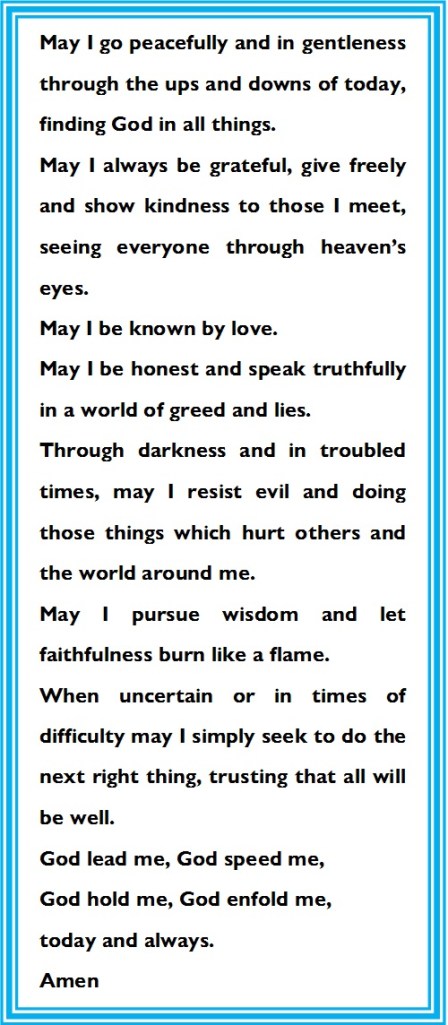
One of the best ways any of us can do this, is to start each morning with a prayer, committing ourselves afresh to this different way of living and asking for help to carry it out. For those in recovery this is Step 11 work (“Sought through prayer and meditation to improve our conscious contact with the God of our understanding”), which is probably the most easily neglected or side-stepped part of the programme. There are of course countless prayers we can use but here is a simple one which helps me to begin each day with fresh resolve to live it well and live it in the right way.